
While designing a wastewater treatment plant, often many designers and contractors make serious mistakes that leads to high costs which are unnecessary. Some of the key mistakes and their remedies are highlighted to help the designers, contractors and owners alike lower not just their capex but also their overall cost of ownership:
- Selection of the High Flood Level of the discharge location
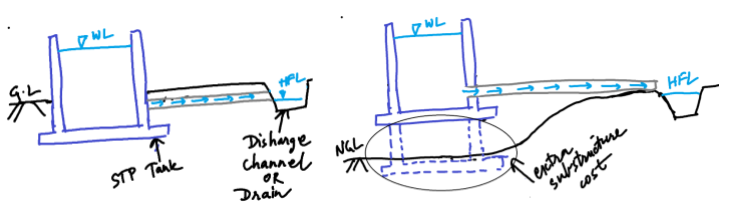
One of the most common mistakes is to select a very high HFL of the treated water discharge point, this significantly increases all your upstream units and their invert level or in simple words the tank bottom. In some cases, the tank bottom becomes so high that it comes outside the ground level. This leads to high cost in substructure cost. Nevertheless, it does not mean that the HFL to be chosen be dangerously low where a storm event can easily submerge the discharge pipe and thus the gravity discharge does not take place.
- The solution is to check with irrigation department or local body or even sometimes people who are familiar with the place, people who can give the HFL point for a 100-year storm event.
- Another option is to also check the historical satellite imagery from google earth to get a board ideal where a particular point gets flooded or not.
- Another solution for if the plant is significantly large and the cost extra civil work for 365 day gravity discharge is higher compared to the power consumption over its 30 year life then the same can be avoided by designing the hydraulics for 9 month dry period where the HFL is much lower and the treated water can be pumped during the extreme conditions
- Overestimating blower capacity
The top most common practice of overestimating the blower capacity by many practitioners, not only increases your capex of the blower but it also leads to increase in the size of motor which leads to higher switchgear costs which leads to higher transformer size and also to DG set size. This has long term implication on recurring capex for transformer, DG set and blower maintenance in terms of oil change and preventive maintenance costs.
The easiest solution is relook the design assumptions especially following:
-
- the Alpha, Beta factors
- denitrification credit to be taken 95% instead of lower 75% which
- residual DO can be considered 1.6-1.8 mg/l down from commonly accepted 2 mg/l practice
- selected higher per diffuser flowrate which reduced the transfer efficiency, consult with diffuser vendor for the same
One can estimate blower capacity from biological treatment through following link
- Overestimating blower pressure
Another practice which is common among the designer, in tandem with the blower capacity often they also select a higher-pressure rating for the blower.
For example if the aeration depth is 5.5 meter, then the discharge pressure taken is 0.65 bar which 20-22% margin over the static head. It has observed by many statistical surveys is that the discharge pressure developed at many plant with capacities ranging from 5 to 100 MLD the discharge pressure losses are not more than 10% from the water depth of the aeration basin. Thus, just by moving from 0.65 bar to 0.6 bar in case of a 5.5 meter water depth of the aeration basin (diffusers are installed 200 mm above the tank bottom, this is considered in the above discussion), the designer may save on 1 motor size for example 75 kW from 90 kW. This again has those same implication as selecting a higher blower capacity
This has long term implication on recurring capex for transformer, DG set and blower maintenance in terms of oil change and preventive maintenance costs.
- Overestimating sludge generation
The sludge is always overestimated, why?. Because, the design raw wastewater parameters are always overestimated. Based on statistical survey of more than 20 plants across India, it was observed that the BOD and nitrogen load estimated for design is mostly 20-405 lower than the actual. Notwithstanding this fact, the design cannot take this into consideration for design as the client strictly follows a minimum benchmark criteria as per the tender specifications and national standards. However, the fact can be considered in an unsaid or tacit form in the sludge yield factor while calculating the sludge generation based on the BOD load. It is advised that the factor to be considered in India shall be 0.5-0.65 kg of TSS per kg pf BOD for SBR and extended aeration processes.
It is also advised that the designer if not confident about the assumptions, he should get extensive testing carried out on a daily basis for a week or 15-20 days and then make a more calculated risk. In worst case scenario the designer can also choose to provide more space in the dewatering building and can always add capacity later when the plant comes into running condition.
One can estimate sludge generation from biological treatment through following link
- Layout not taking advantage of topography
Not so common but still widely observed in more than 30% plants, that the placement of the units is not taking the advantage of the natural contours. Meaning, the delta height in the land is ranging from 2-3 meters or even higher, the units which has a lower invert level shall be placed in the lower ground and vice versa, this was once can save on both the substructure cost as well as the excavation cost.