
Blowers are the linchpin of any modern sewage or wastewater treatment plants. An equipment so critical to the operation and also contributing to around 60-80% of the overall treatment power consumption. Thus, it becomes imperative for a designers and an operator to know how can their decisions and actions have deep impact on the power consumption due to blowers. Some of the strategies to reduce blower power consumption are described below:
- Reducing the water depth till 5.2-5.3 meter above the diffuser top
- By limiting the static water depth over diffuser to 5.3 meter approximately it reducing the discharge pressure requirements and thus the blower motor rating as well as effective power consumption by lower frictional losses in pipe under lower back pressure and also by helps in keeping the blower/machine at lower temperatures
- On the other side one should also not reduce the blower static head blow 4.5 meter in water culumn, as the same also reduces the oxygen transfer efficiency and increase the flowrate requirement increasing the blower effective power consumption
- For example, the blower with 1000 Ncum/hr @ 0.6 bar pressure has a 30 kW motor and 1000 Ncum/hr @0.66 bar pressure has a 45 kW motor.
- The key is to find the optimal point for the flowrate and water depth
- Selected lower flow rate per diffuser to increase the SOTE of diffuser based on manufacturer datasheet
Generally, manufacturer provide a standard curve for diffuser SOTE performance with respect to the flowrate per diffusers as shown below
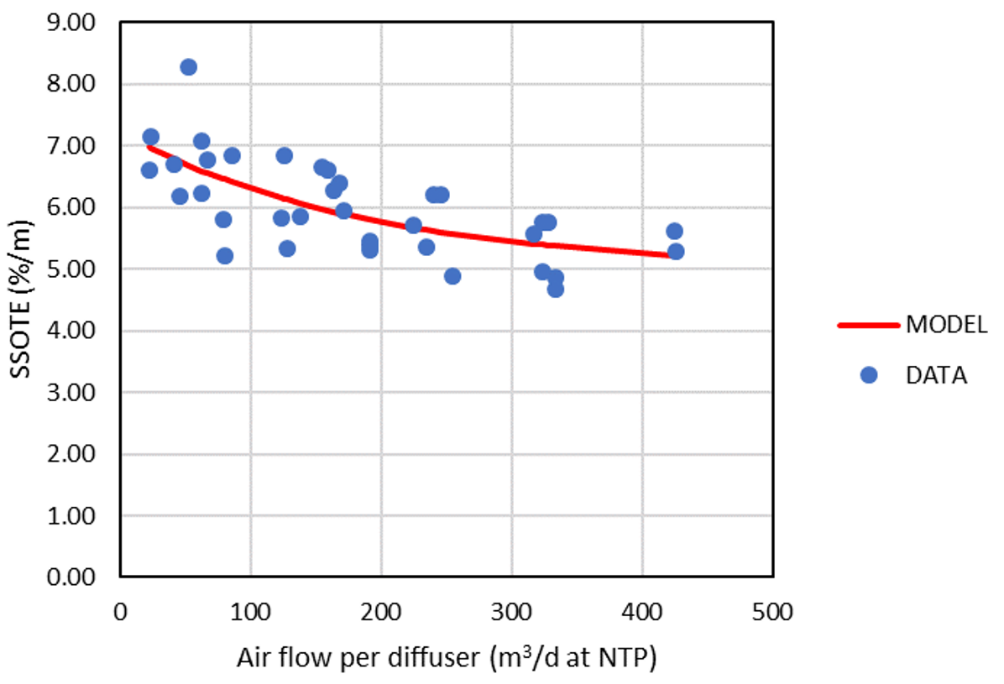
As it can be seen from the typical curve the efficiency increases as the design air flow rate is reduced per diffuser. This has a drastic effect on the blower capacity as with a 1% point change from 5 to 6 % the blower capacity and power consumption is reduced by 20%. Nevertheless, the same shall be evaluated by modelling the diurnal air flow requirements, effective power consumption over the day and diffuser capex and recurring capex for replacement along with a 15-20 year project lifecycle assessment. A good way is to build a excel spreadsheet or use modelling touls like SUMO (Dynamita) or BioWin
- Limit pipeline losses by selecting velocity in pipe till 18 m/s
This helps to keep the frictional losses in check and thus reduce the blower discharge pressure requirement and thus ultimately the power consumption. This also helps reduction in sound and vibrations
- Use oh high efficiency blower technologies like – Screw blowers, hybrid & turbo
Screw & Turbo blowers offer significant efficiency improvements compares to the conventional roots blower by up to 20-25%. Even in case of roots blower the tri lobe should be preferred in case of high flowrate capacities like >1000 Ncum/hr.
- Combination blower technology for variable oxygen demand – Screw, roots & turbo in the same plant
Often times overlooked aspect of high efficiency blowers like turbo is that they generally give the energy saving in a particular range of operation and reducing the speed below a certain point in fact generally becomes nonproductive. The solution to this is to provide a combination of blower technology in the same plant to handle the diurnal variation in the air demand-based plant’s actual flowrate and organic loading.
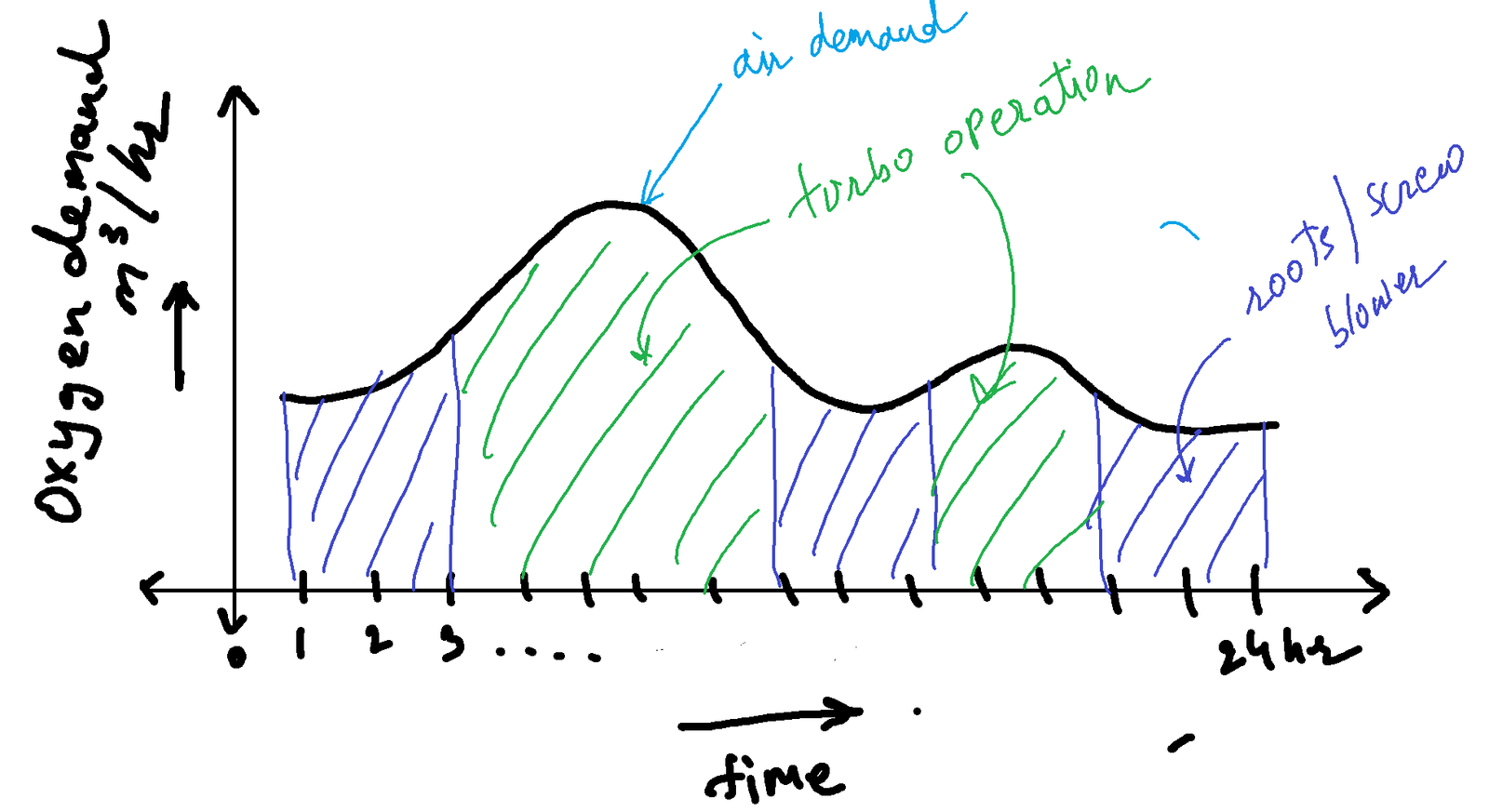
For example, the high volumetric demand during particular time of the day turbo blower be used where they can be run near their best efficiency point, while during other periods the roots blower can be used, which has a higher turndown ratio an flexibility compared to the turbo blowers. Moreover, there are cases where in if the water depth is much higher the designer can also shift to a screw blower which can handle higher discharge pressure without increase in the effective power consumption.
- Cleaning diffusers regularly to avoid fouling once every 6-8 months
Regular diffuser cleaning provides the most bang for the buck in terms of cost. Often overlooked aspect is very critical to avoid diffuser fouling and maintain the air transfer efficiency and lower discharge pressure requirement
- High quality Dissolved oxygen analyser & regular maintenance for probe for regulating blower speed
The most important analyser in a biological based wastewater treatment plant is dissolved oxygen (DO) sensor, even more important that any water quality analysers. This also one of the most overlooked instrument in terms of preventive maintenance. This is very critical for regulating the blower speed based on the DO concentration in the aeration basin via Variable Frequency Drive (VFD), and for a reliable and accurate feedback a good quality well maintained analyser is imperative and mandatory.