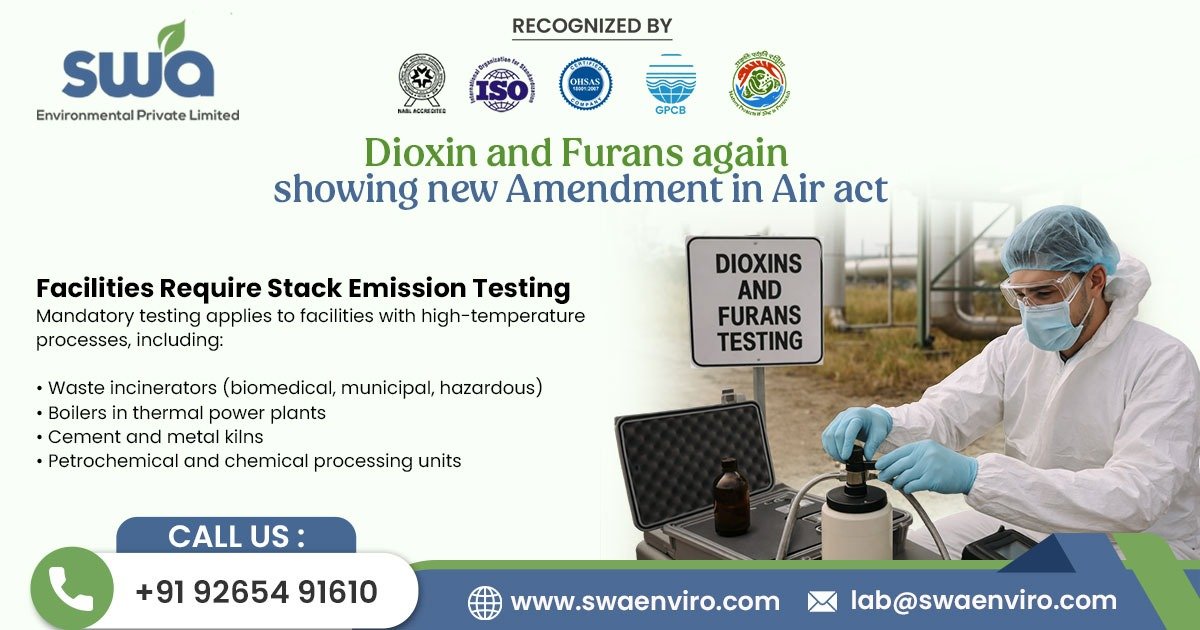
Dioxins and furans are highly toxic chemical compounds formed unintentionally during combustion and high-temperature industrial processes.
Key Sources:
-
Municipal and biomedical waste incinerators
-
Hazardous waste burning
-
Cement kilns
-
Thermal power plants
-
Metallurgical and chemical industries
Why They Are Dangerous:
-
Persistent in the environment
-
Bioaccumulate in the food chain
-
Linked to cancer, immune disorders, reproductive and developmental issues
-
Harmful even at ultra-trace concentrations
Because of these risks, regulators mandate strict emission standards and periodic stack monitoring.
Overview of the Air Act and Recent Compliance Updates
The Air (Prevention and Control of Pollution) Act, 1981 empowers regulatory authorities to control and prevent air pollution across India.
Recent Regulatory Improvements (2026 Updates):
-
Streamlined consent processes
-
Integrated compliance for air, water, and hazardous waste
-
Increased accountability through audits
-
Stronger enforcement of toxic emission limits
-
Digitized compliance documentation
These updates emphasize trace toxic pollutant monitoring, including dioxins and furans, especially for red-category industries.
Regulatory Standards for Dioxins and Furans in India
The Central Pollution Control Board (CPCB) prescribes strict limits for dioxin and furan emissions.
Current Emission Limit:
-
0.1 ng TEQ/Nm³ for total dioxins and furans (for applicable industries)
Compliance Requirements:
-
Periodic stack emission testing
-
Use of approved sampling methods (e.g., isokinetic sampling)
-
Laboratory analysis using high-resolution techniques
-
Submission of reports to State Pollution Control Boards
Failure to Comply May Result In:
-
Show-cause notices
-
Penalties and fines
-
Consent suspension or revocation
Importance of Stack Testing for Dioxin and Furan Control
Stack emission testing is the most reliable method to measure ultra-trace toxic pollutants.
Why It Is Critical:
-
Detects pollutants at extremely low concentrations
-
Validates compliance with CPCB norms
-
Supports Consent to Operate (CTO) documentation
-
Strengthens ESG and sustainability reporting
-
Identifies process inefficiencies
Industries must conduct annual or regulatory-mandated monitoring depending on category and pollution load.
How SWA Environmental Private Limited Supports Compliance
SWA Environmental Private Limited is a specialized environmental testing laboratory offering advanced Dioxin and Furan Testing Services in India.
SWA’s Key Capabilities:
Advanced Analytical Technology:
-
High-Resolution Gas Chromatography / High-Resolution Mass Spectrometry (HRGC/HRMS)
-
Detection at ultra-trace levels (ppt range)
Comprehensive Sampling Services:
-
Stack emissions
-
Ambient air
-
Soil and water
-
Fly ash and industrial residues
-
Feedstock and environmental samples
Regulatory Compliance Support:
-
CPCB-aligned testing methodology
-
Audit-ready documentation
-
Technical guidance for emission control strategies
Industry Coverage:
-
Waste-to-energy plants
-
Biomedical waste facilities
-
Cement and metal industries
-
Chemical manufacturing units
By partnering with SWA Environmental, industries gain accurate data, faster reporting, and regulatory confidence.
Industries Most Impacted by the Amendment
The latest compliance framework particularly impacts:
-
Municipal solid waste incinerators
-
Biomedical waste incineration units
-
Hazardous waste disposal facilities
-
Thermal power plants
-
Cement kilns co-processing waste
-
Metallurgical industries
SWA Environmental Private Limited is a trusted provider of the Latest Air Act Amendment for Dioxin and Furan Services in Gujarat, including Ahmedabad, Surat, Vadodara, Rajkot, Bhavnagar, Jamnagar, Anand, Gandhinagar, Bharuch, Morbi, Vapi, Valsad, Junagadh, Nadiad, Mehsana, Porbandar, Godhra, Navsari, Surendranagar, Patan, Amreli, Palanpur, Modasa, Dahod, Gandhidham, Bhuj, Ankleshwar, Kalol, Sanand, Halol, Kadi, Khambhat, Jetpur, Kutch, Mundra, Morbi, Rajpipla, Dwarka, Dholka, Gandharpur, Bhachau, Chotila, Dhandhuka, Umargam, Padra, Jhagadia, Kalol, Savli, Sachin, Palghar, Godhra, Vallabh Vidyanagar, Mandvi, Halvad, Balasinor, Nandesari, Pardi, Karamsad, and many more.
Contact Information:
-
Phone: +91 9227988980
-
Email: lab@swaenviro.com
-
Website: www.swaenviro.com