
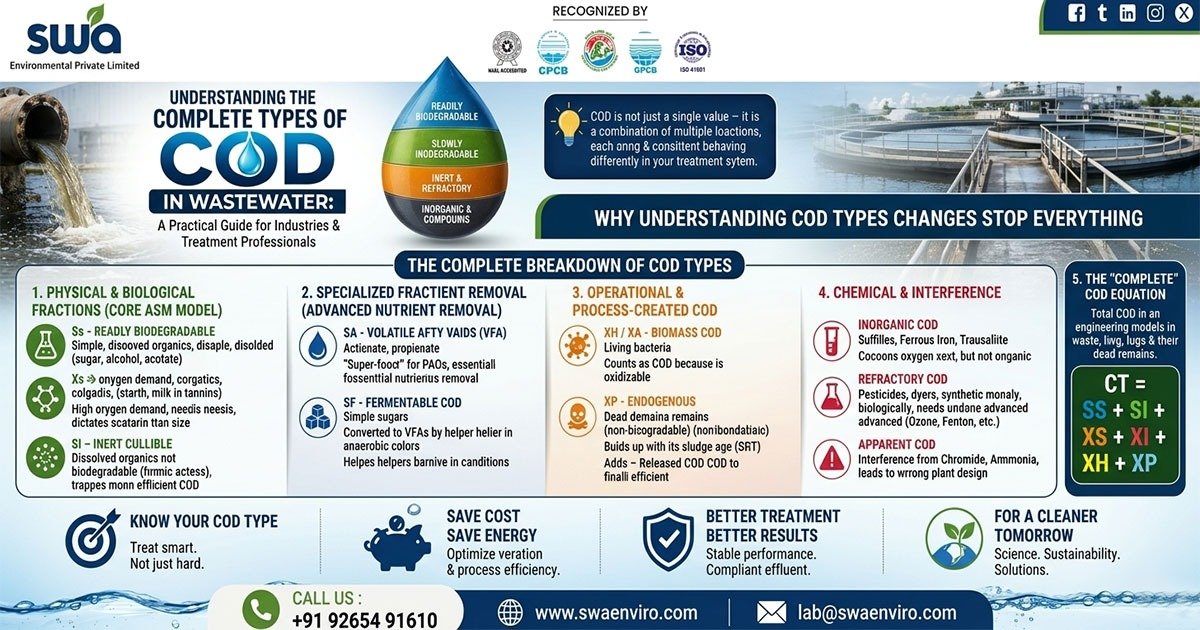
A Practical Guide for Industries & Treatment Professionals by SWA Environmental Private Limited In wastewater treatment, Chemical Oxygen Demand (COD) is
one of the most commonly measured parameters. Almost every industry tracks COD to monitor pollution levels and treatment performance.
But here’s a critical reality many overlook:
👉 COD is not just a single value—it is a combination of multiple fractions, each behaving differently inside your treatment system.
Ignoring this complexity often leads to:
• Inefficient plant design
• High outlet COD despite treatment
• Increased operating costs
• Trial-and-error troubleshooting
At SWA Environmental Private Limited, we believe that understanding the complete nature of COD is the key to building efficient, reliable, and compliant wastewater treatment systems.
🌡️ What Does COD Really Represent?
COD measures the total oxygen required to chemically oxidize all oxidizable substances in wastewater.
This includes:
• Easily degradable organics
• Complex organic matter
• Non-biodegradable compounds
• Even some inorganic substances
So while COD gives a number, it does not directly tell you:
❌ How much can actually be treated biologically
❌ How much will remain in the effluent
❌ Why your treatment plant is underperforming
To answer these questions, we need to break COD into its true components.
Bridging the Gap: The Ultimate Guide to COD Fractionation for Chemists and Engineers
If there is one number that rules the wastewater world, it’s Chemical Oxygen Demand (Total COD).
But a single Total COD (CT) value does not tell an engineer how fast it will break down or how a system will behave. To design and operate a treatment plant effectively, COD must be divided into meaningful fractions based on biodegradability and behavior.
1. The Physical & Biological Fractions (The Core ASM Model)
Readily Biodegradable COD (Ss): The Rocket Fuel
What it is: Simple, dissolved molecules eaten instantly (e.g., glucose, vinegar).
The Impact: Creates immediate oxygen demand and supports denitrification in aeration systems.
Slowly Biodegradable COD (Xs): The Meat and Potatoes
What it is: Complex molecules (starches, proteins) and colloidal matter.
The Impact: Requires hydrolysis before degradation and influences aeration tank sizing.
Inert Soluble (Si) & Inert Particulate (Xi): The Dead Weight
What they are:
• Si: Dissolved non-biodegradable compounds
• Xi: Solid non-degradable particles
The Impact:
• Si passes through to effluent
• Xi accumulates in sludge, increasing disposal load
2. Specialized Fractions (Advanced Nutrient Removal)
Volatile Fatty Acids (SA)
Highly available carbon sources like acetate used directly by PAOs in phosphorus removal systems.
Fermentable COD (SF)
Simple organics that are converted into VFAs by bacteria in anaerobic conditions.
Stored COD (XSTO)
Internal energy reserves within bacteria, helping them survive fluctuating conditions.
3. Operational & Process-Created COD
Biomass COD (XH / XA)
COD contribution from living microorganisms themselves.
Endogenous Residue (XP)
Non-biodegradable remains of dead microbial cells that accumulate over time.
Soluble Microbial Products (SMP)
UAP (Utilization Associated Products)
By-products generated during active substrate consumption.
BAP (Biomass Associated Products)
Released during cell decay and lysis.
4. Chemical & Interference COD (The Lab “Gotchas”)
Inorganic COD
Oxygen-consuming inorganic substances like sulfides, ferrous iron, nitrites, and thiosulfates.
Refractory COD (Hard COD)
Persistent industrial compounds such as dyes and pesticides that resist biological degradation.
Apparent COD
False or inflated COD readings caused by interferences like chlorides or ammonia during testing.
5. The “Complete” COD Equation
Total COD Representation
CT = SS + SI + XS + XI + XH + XP
The Master Summary Matrix
COD Fraction Overview
| Category | Specific Type | Real-World Example | Primary Engineering Impact |
|---|---|---|---|
| Physical | Particulate | Bread crumbs / tissue bits | Drives primary sludge production |
| Biological | Readily Bio (Ss) | Sugar / alcohol | Immediate oxygen demand |
| Advanced | VFA (SA) | Acetate | Required for phosphorus removal |
| Metabolic | SMP | Bacterial by-products | Increases effluent COD |
| Chemical | Inorganic | Sulfides | Skews aeration design |
| Industrial | Refractory | Dyes / pesticides | Requires advanced oxidation
|
Why Understanding COD Types Changes Everything
Better Treatment Design
Different COD fractions determine aeration needs, reactor sizing, sludge production, and technology selection.
Realistic Effluent Expectations
Minimum achievable COD is limited by inert COD and microbial by-products.
Faster Troubleshooting
• High Si → Need tertiary treatment
• High Xs → Improve hydrolysis
• High SMP → Optimize biological process
Cost Optimization
Wrong interpretation leads to overdesign and high energy consumption, while correct understanding improves efficiency and stability.
How SWA Environmental Private Limited Helps
Advanced Wastewater Solutions
At SWA Environmental Private Limited, we go beyond routine testing:
• COD analysis with interpretation
• BOD/COD ratio evaluation
• Treatability assessment
• ETP troubleshooting
• Advanced treatment recommendations
We help industries understand not just how much COD is present—but what kind of COD it is.
Final Thoughts
COD is not just a number—it is a complete story of your wastewater.
When broken into its true fractions:
• You understand what can be treated
• What cannot be treated
• And what requires advanced solutions
That’s the difference between guessing and engineering.
Contact Information
• Phone: +91 9227988980
• Email: lab@swaenviro.com
• Website: www.swaenviro.com