Understanding the Difference Is Critical for Environmental Compliance & Workplace Safety
By SWA Environmental Private Limited
Our registered office, manufacturing facility, and advanced laboratories are located in Ahmedabad and Jaipur, India.
In environmental monitoring and industrial compliance, terms like Ambient Air Quality, Indoor Air Quality (IAQ), and Fugitive Emission Monitoring are often used interchangeably.
But in reality:
⚠️ They are completely different types of air quality assessments.
Many industries unknowingly perform the wrong type of monitoring, leading to:
Incorrect compliance reporting
Regulatory non-conformities
Poor workplace safety management
Ineffective pollution control decisions
Wasted monitoring costs
At SWA Environmental Private Limited, we frequently observe confusion between these three critical monitoring categories. Understanding their differences is
essential for industries, consultants, EHS professionals, and facility managers.
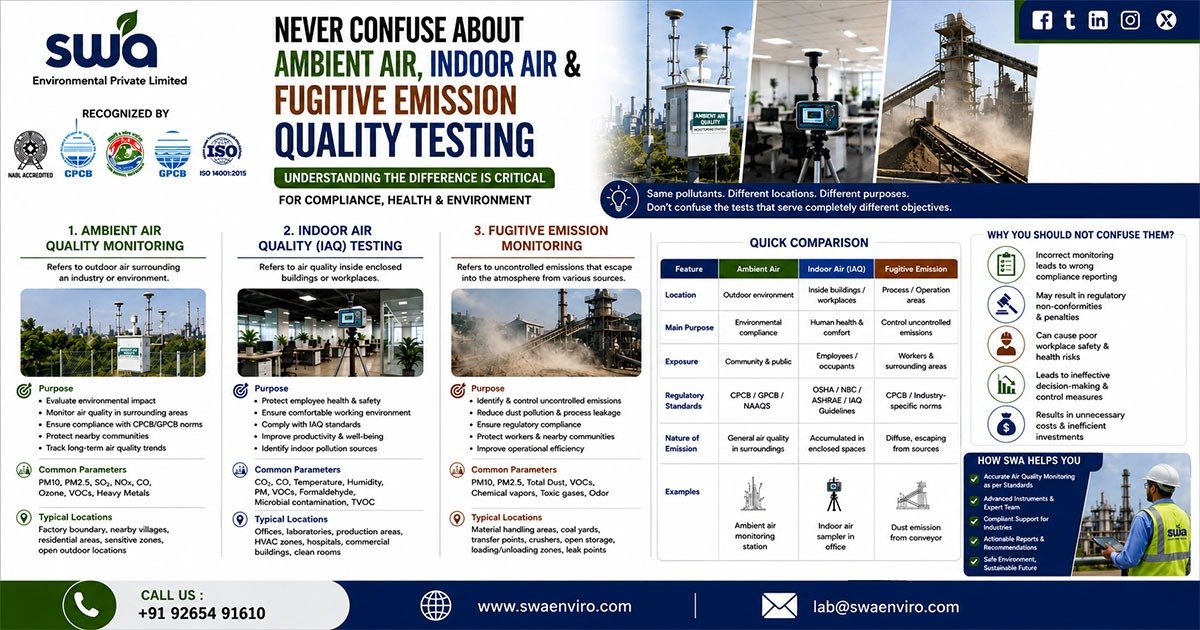
🌤️ 1. What Is Ambient Air Quality Monitoring?
Ambient Air refers to the outdoor air surrounding an industry or environment.
Ambient Air Quality Monitoring measures the concentration of pollutants present in the surrounding atmosphere due to:
Industrial emissions
Vehicular pollution
Construction activities
Dust dispersion
Urban pollution sources
✅ Purpose of Ambient Air Monitoring
Ambient monitoring helps evaluate:
✔️ Environmental impact of industries
✔️ Air pollution levels in surrounding areas
✔️ Compliance with CPCB/GPCB norms
✔️ Impact on nearby residential zones
✔️ Long-term environmental quality trends
🔬 Common Parameters in Ambient Air Testing
Typical parameters include:
PM10
PM2.5
SO₂ (Sulfur Dioxide)
NOx (Nitrogen Oxides)
CO (Carbon Monoxide)
Ozone
VOCs
Heavy metals
📍 Where Is Ambient Monitoring Conducted?
Usually monitored at:
Factory boundary areas
Nearby villages/residential areas
Sensitive environmental zones
Open outdoor locations
🏢 2. What Is Indoor Air Quality (IAQ) Testing?
Indoor Air Quality refers to the quality of air inside enclosed buildings or workplaces.
This includes:
Offices
Laboratories
Production halls
Commercial buildings
Hospitals
Clean rooms
HVAC-controlled environments
Indoor air quality directly affects:
✔️ Employee health
✔️ Productivity
✔️ Occupational safety
✔️ Comfort levels
⚠️ Why Indoor Air Testing Is Important
Poor IAQ may cause:
Headaches
Allergies
Respiratory irritation
Eye irritation
Sick Building Syndrome (SBS)
Fatigue & low productivity
Unlike ambient air, indoor pollution often accumulates due to poor ventilation and confined spaces.
🔬 Common Indoor Air Parameters
Indoor air testing commonly includes:
CO₂
CO
Temperature & humidity
Particulate matter
VOCs
Formaldehyde
Microbial contamination
Airborne bacteria & fungi
📍 Where IAQ Monitoring Is Performed
Typically inside:
Workstations
Laboratories
Pharmaceutical areas
HVAC zones
Storage rooms
Occupied indoor environments
🌫️ 3. What Are Fugitive Emissions?
Fugitive emissions are uncontrolled emissions that escape into the atmosphere without passing through a stack or chimney.
These emissions are typically released from:
Material handling
Conveyor belts
Crushers
Open storage yards
Loading/unloading operations
Leaking valves & pipelines
Chemical handling areas
Unlike stack emissions, fugitive emissions are diffuse and difficult to capture.
⚠️ Why Fugitive Emission Monitoring Is Critical
Fugitive emissions can cause:
Dust pollution
Worker exposure risks
Regulatory non-compliance
Poor visibility
Product contamination
Community complaints
Industries like cement, mining, chemicals, steel, power plants, and bulk material handling facilities are especially vulnerable.
🔬 Common Fugitive Emission Parameters
Monitoring may include:
PM10
PM2.5
Total dust
VOC leakage
Chemical vapors
Toxic gases
Odor monitoring
📍 Typical Fugitive Emission Areas
Coal yards
Raw material handling zones
Transfer points
Crushers & mills
Open process areas
Chemical storage zones
📊 Quick Comparison Table
| Type | Location | Main Purpose | Typical Concern |
|---|---|---|---|
| Ambient Air | Outdoor environment | Environmental compliance | Community pollution |
| Indoor Air | Inside buildings | Human health & comfort | Employee exposure |
| Fugitive Emission | Process leakage areas | Uncontrolled emission control | Dust & process leakage |
🚨 Why Confusing These Tests Can Be Dangerous
❌ Incorrect regulatory reporting
❌ Missed pollution sources
❌ Unsafe workplace conditions
❌ Poor pollution control investment
❌ Legal & compliance risks
Each monitoring type serves a completely different engineering and regulatory objective.
🏭 How SWA Environmental Private Limited Helps
At SWA Environmental Private Limited, we provide comprehensive environmental monitoring solutions including:
✔️ Ambient Air Quality Monitoring
✔️ Indoor Air Quality Assessment
✔️ Fugitive Emission Monitoring
✔️ Stack Emission Testing
✔️ Occupational Exposure Assessment
✔️ Environmental Compliance Support
Our expert team helps industries:
Understand the correct monitoring requirement
Meet CPCB/GPCB compliance
Improve workplace safety
Optimize pollution control systems
Maintain environmental sustainability
🚀 Final Thoughts
Ambient Air, Indoor Air, and Fugitive Emission monitoring may sound similar—but they are entirely different environmental assessments.
Understanding the difference helps industries:
✔️ Monitor correctly
✔️ Stay compliant
✔️ Protect workers
✔️ Reduce pollution
✔️ Improve operational control
Because effective environmental management starts with understanding what exactly you are monitoring—and why.
Contact
- Visit: www.swaenviro.com
- Phone: +91 9227988980
- Email: lab@swaenviro.com