
Industrial heating systems—boilers, hot air generators, thermic fluid heaters, and steam generators—are the backbone of manufacturing. From textiles and chemicals to food processing, paper, pharmaceuticals, and metal industries, reliable and efficient fuel is essential to keep operations running smoothly.
But here’s the challenge:
Not all fuels are created equal.
And without accurate calorific value data, industries are essentially burning money in the firebox.
This is where scientific fuel testing—especially calorific value (CV) analysis—becomes mission-critical.
🌡️ What Is Calorific Value (CV)?
Calorific Value is the amount of energy released when a fuel is completely burned.
Units of Measurement
- kcal/kg
- kJ/kg
- MJ/kg
Key Insight
- Higher CV = More heat output = Lower fuel consumption
- Lower CV = Poor heat performance = Higher operating cost
Every industry that relies on combustion must know the actual, lab-verified CV of its fuel.
⭐ Why Testing Calorific Value Is Essential for Industries
1. Accurate Heat Calculations for Boilers & Heating Systems
Boiler efficiency, steam generation rate, and heat transfer output all depend on the true energy content of the fuel.
Risks of Inaccurate CV
- Drop in steam output
- Unstable furnace temperature
- Slower production cycles
- Increased fuel consumption
Benefit
Precise CV enables correct boiler sizing, stable combustion, and efficient fuel planning.
2. Controlling Operating Costs & Avoiding Overconsumption
Fuel is one of the largest operational expenses.
Impact of Small CV Variations
- 8–15% higher fuel usage
- Increased electricity consumption
- Equipment stress
- Operational inefficiencies
Benefit
Accurate CV ensures optimized fuel usage and significant cost savings.
3. Ensuring Genuine Quality When Purchasing Fuel
Suppliers often claim high CV values for fuels like:
- Coal (Indian & imported)
- Biomass briquettes
- Sawdust pellets
- Mustard husk
- RDF (Refuse Derived Fuel)
- Bagasse, bio-coke, and more
Common Issues
- High moisture content
- Adulteration
- Inconsistent quality
Benefit
Third-party testing ensures:
- You pay for actual quality
- Supplier claims are verified
- No low-grade fuel enters your system
4. Reducing Carbon Emissions & Meeting Sustainability Targets
Low CV fuels lead to inefficient combustion.
Environmental Impact
- Increased smoke and particulates
- Higher CO₂ emissions
- Soot and slag formation
Benefit
CV testing helps:
- Compare fuel options (bio vs coal)
- Optimize combustion efficiency
- Meet ESG and sustainability goals
5. Preventing Equipment Damage & Safety Hazards
Inconsistent CV directly affects system stability.
Risks
- Temperature fluctuations
- Over-firing
- Tube overheating
- Clinker formation
- Pressure instability
Benefit
Accurate CV ensures safe, stable, and controlled combustion.
💡 What Should Be Tested Along with Calorific Value?
For complete fuel analysis, industries should test:
Essential Parameters
- Gross Calorific Value (GCV)
- Net Calorific Value (NCV)
Supporting Parameters
- Ash content
- Moisture content
- Volatile matter
- Fixed carbon
- Sulphur content
- Chlorine (especially for biomass fuels)
These parameters provide a full picture of combustion efficiency and fuel quality.
🔬 Why Genuine, NABL-Accredited Test Results Matter
Reliable results come only from certified processes and facilities.
Key Requirements
- Calibrated bomb calorimeters
- NABL-accredited laboratories
- Standard testing methods (ASTM / ISO / BIS)
- Skilled analysts
Risks of Non-Certified Testing
- Billing disputes
- Poor combustion planning
- Inefficient fuel procurement
- Reduced boiler performance
Benefit
Trusted results enable accurate decision-making and operational reliability.
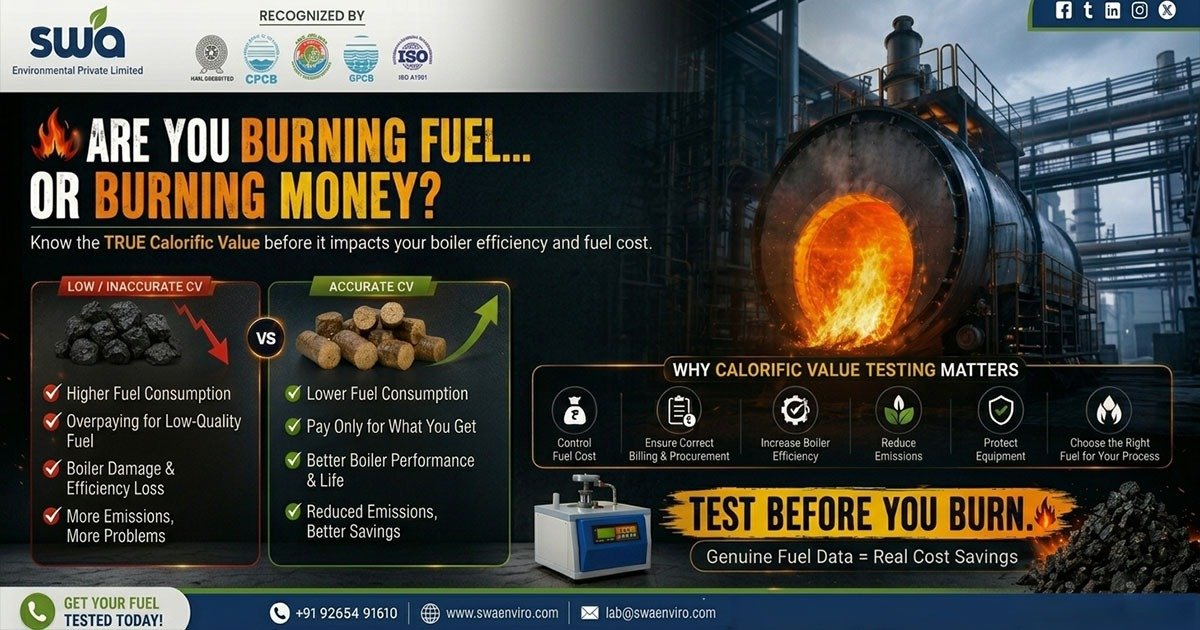
🚀 Summary: Why Calorific Value Testing Is Non-Negotiable
Key Advantages
- ✔ Controls fuel costs
- ✔ Ensures accurate billing
- ✔ Improves boiler efficiency
- ✔ Reduces emissions
- ✔ Protects equipment
- ✔ Prevents operational losses
- ✔ Helps select the right fuel
Calorific value testing is not optional—it is the core of efficient industrial energy management. Whether using coal, biomass, pellets, or alternative fuels, accurate CV data ensures performance, safety, and profitability.