Why Proper Workplace Lighting is More Than Just Visibility
Author:
Pankaj Gothi
COO – Laboratory Division
SWA Environmental Private Limited
Introduction
Lighting is one of the most overlooked workplace environmental factors.
When industries think about occupational hazards, they usually focus on chemical exposure, dust, noise, vibration, heat stress, or air quality.
However, inadequate illumination can be equally hazardous.
Poor lighting affects employee safety, visual performance, product quality, inspection accuracy, machine operation, mental alertness, and overall productivity. It increases the likelihood of human error, accidents, eye strain, and long-term visual fatigue.
Whether it is a pharmaceutical cleanroom, semiconductor manufacturing plant, warehouse, laboratory, production floor, office, hospital, or inspection room, maintaining appropriate illumination levels is essential for creating a safe and efficient working environment.
This is why Lux Level Measurement has become an integral part of Occupational Health, Industrial Hygiene, Factory Safety Audits, ISO Management Systems, and Good Manufacturing Practices (GMP).
What is Illumination?
Illumination is the amount of light falling on a surface.
Unlike the brightness of a lamp, illumination represents the actual light available for performing a task.
The SI unit of illumination is Lux (lx).
One Lux equals one lumen of light uniformly distributed over one square metre.
In simple terms:
Higher Lux = Better visibility.
Lower Lux = Poor visibility and increased occupational risk.
Why is Lux Level Measurement Important?
Adequate illumination is essential because human vision directly influences workplace safety and operational performance.
Proper lighting helps employees:
- Read instruments accurately
- Operate machinery safely
- Detect product defects
- Perform precision assembly
- Reduce visual fatigue
- Improve concentration
- Increase productivity
- Minimize workplace accidents
Conversely, insufficient lighting often results in:
- Eye strain
- Headaches
- Reduced work efficiency
- Incorrect measurements
- Inspection errors
- Slips, trips, and falls
- Operator fatigue
- Increased accident rates
For industries handling precision manufacturing, laboratory testing, quality control, or detailed inspection work, lighting quality directly affects product quality.
Understanding Lux
Many people confuse:
- Watt
- Lumen
- Lux
Although related, they measure different aspects of lighting.
| Parameter | What it Measures |
| Watt (W) | Electrical power consumed |
| Lumen (lm) | Total light emitted by the source |
| Lux (lx) | Light actually reaching the working surface |
A high-wattage lamp does not necessarily provide adequate workplace illumination.
Only Lux measurement tells whether the worker receives sufficient light to perform the task safely.
Why Measure Lux Instead of Counting Light Fixtures?
Many facilities assume that installing additional LED fixtures automatically ensures adequate lighting.
This assumption is often incorrect.
Several factors influence actual illumination:
- Mounting height
- Fixture spacing
- Reflectance of walls and ceilings
- Dust accumulation on luminaires
- Ageing of lamps
- Obstructions
- Natural daylight
- Equipment layout
Only field measurements using a calibrated Lux Meter can determine whether illumination complies with recommended workplace standards.
How is Lux Level Measured?
Lux measurements are performed using a calibrated digital Lux Meter.
The instrument contains a photosensitive sensor that measures the intensity of incident light at the working plane.
Measurements are typically taken at the task level—for example:
- Desk height in offices
- Workbench height in workshops
- Machine operating level
- Laboratory benches
- Inspection tables
- Cleanroom workstations
Multiple readings are recorded across the work area to evaluate lighting uniformity and identify dark spots.
Factors Affecting Workplace Illumination
Workplace lighting is influenced by numerous environmental and operational factors:
Lighting Design
Improper luminaire placement may create uneven illumination.
Lamp Age
Light output gradually decreases as lamps age.
Dust and Dirt
Dust accumulation on fixtures can significantly reduce illumination levels.
Ceiling Height
Higher mounting heights reduce illumination at the work surface.
Surface Reflectance
Dark walls and ceilings absorb light, while lighter surfaces improve illumination.
Equipment Arrangement
Large machinery or storage racks may block light and create shadows.
Daylight Availability
Natural sunlight changes throughout the day and must be considered during assessments.
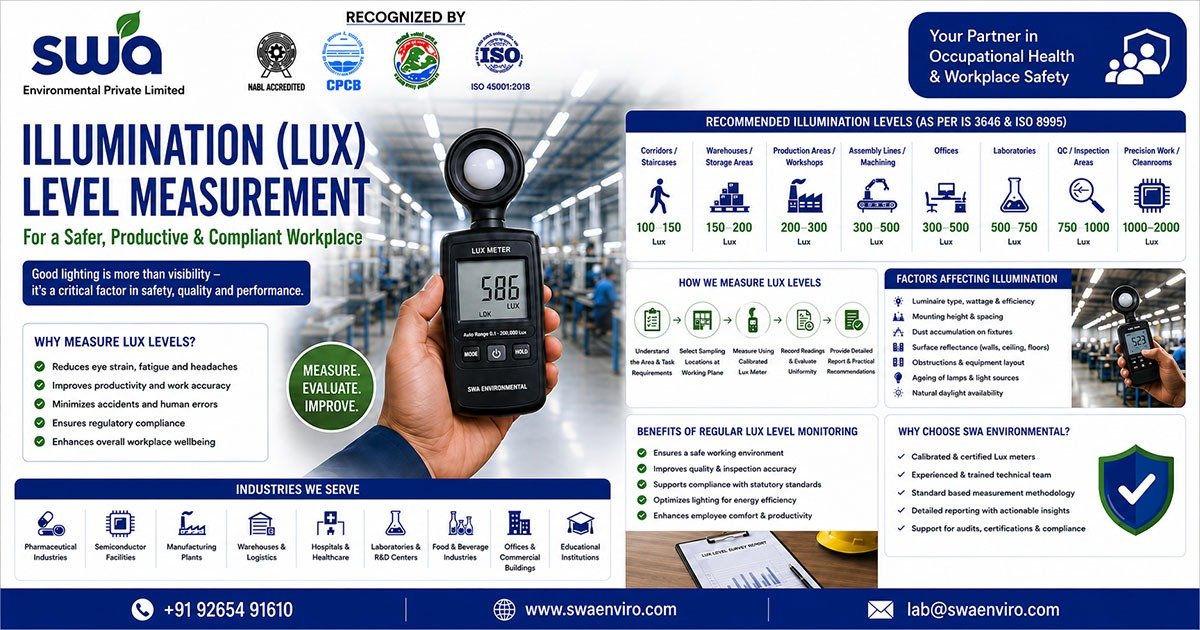
Recommended Illumination Levels for Different Work Areas
The required Lux level depends on the nature of the task being performed.
| Workplace Area | Typical Recommended Illumination |
| Corridors | 100–150 Lux |
| Warehouses | 150–200 Lux |
| General Production Areas | 200–300 Lux |
| Assembly Lines | 300–500 Lux |
| Offices | 300–500 Lux |
| Laboratories | 500–750 Lux |
| Quality Control Laboratories | 750–1000 Lux |
| Pharmaceutical Manufacturing | 500–1000 Lux |
| Semiconductor Cleanrooms | 750–1500 Lux |
| Precision Inspection Areas | 1000–2000 Lux |
Actual requirements should always align with applicable industry standards and task-specific recommendations.
Why Illumination is Critical in Different Industries
Pharmaceutical Industry
Proper lighting is essential for visual inspection, batch documentation, GMP compliance, and contamination control.
Semiconductor Manufacturing
Micron-level fabrication and inspection demand extremely consistent illumination to maintain precision and reduce operator error.
Food Industry
Adequate lighting supports hygiene inspections, packaging quality, and contamination detection.
Laboratories
Analytical testing, titrations, microscopy, and instrument operation require stable illumination for accurate results.
Warehouses
Good lighting improves material handling safety, inventory management, and forklift operations.
Manufacturing Plants
Proper illumination enhances machine operation, reduces accident risk, and supports quality assurance.
Common Problems Identified During Lux Surveys
Professional Lux surveys often reveal issues such as:
- Uneven lighting distribution
- Dark zones near machinery
- Over-illumination causing glare
- Shadow formation
- Flickering light sources
- Poor emergency lighting
- Dirty luminaires
- Inadequate task lighting
Addressing these issues improves both safety and operational efficiency.
Applicable Standards and Guidelines
Lux level assessments are commonly performed with reference to:
- Factories Act
- National Building Code (NBC)
- IS 3646 – Code of Practice for Interior Illumination
- ISO 8995 – Lighting of Indoor Workplaces
- CIE (International Commission on Illumination)
- Occupational Safety Guidelines
- Good Manufacturing Practices (GMP)
- ISO 45001 Occupational Health & Safety Management Systems
Compliance with these standards helps organizations maintain safe and productive work environments.
Benefits of Routine Lux Level Monitoring
Regular illumination assessments help organizations:
✔ Improve workplace safety
✔ Reduce eye strain and visual fatigue
✔ Enhance employee productivity
✔ Improve product inspection accuracy
✔ Minimize workplace accidents
✔ Support GMP and ISO compliance
✔ Optimize energy-efficient lighting systems
✔ Improve employee comfort and well-being
How SWA Environmental Private Limited Can Help
At SWA Environmental Private Limited, we provide professional Illumination (Lux) Level Measurement Services for industrial, commercial, healthcare, and institutional facilities using calibrated Lux Meters.
Our services include:
Workplace Illumination Surveys
- Production Areas
- Laboratories
- Pharmaceutical Facilities
- Semiconductor Plants
- Warehouses
- Offices
- Hospitals
- Educational Institutions
- Commercial Buildings
Additional Occupational Hygiene Services
- Noise Level Monitoring
- Indoor Air Quality (IAQ) Assessment
- Personal Air Sampling
- Heat Stress Monitoring
- Thermal Comfort Assessment
- Stack Emission Monitoring
- Ambient Air Quality Monitoring
Our detailed reports include:
- Lux Measurement Results
- Lighting Uniformity Assessment
- Compliance Evaluation
- Identification of Deficient Areas
- Technical Recommendations for Improvement
Frequently Asked Questions (FAQs)
What is Lux?
Lux is the SI unit of illumination and represents the amount of light falling on a surface. One Lux equals one lumen per square metre.
Why is Lux measurement important?
It ensures that workplace lighting is adequate for safe operations, reduces eye strain, improves productivity, and supports compliance with occupational safety standards.
How is Lux measured?
Using a calibrated digital Lux Meter positioned at the task or working plane to measure the actual illumination received by workers.
How often should illumination surveys be conducted?
Organizations should assess lighting during commissioning, after significant layout or lighting changes, and periodically as part of occupational health and safety programs.
Can LED lighting still produce poor illumination?
Yes. Incorrect fixture placement, insufficient quantity, glare, dust accumulation, or improper maintenance can result in inadequate Lux levels even with modern LED systems.
Illuminate Workplaces. Improve Performance. Protect People.
Good lighting is more than an engineering requirement—it is a critical element of occupational safety, product quality, and employee well-being.
Routine Lux Level Measurement enables organizations to identify lighting deficiencies, optimize workplace conditions, reduce operational risks, and create environments where people can work safely and efficiently.
At SWA Environmental Private Limited, we provide accurate illumination surveys, technical expertise, and actionable recommendations to help industries achieve better lighting performance and regulatory compliance.
We provide Illumination (Lux) Level Measurement in Workplaces Services in Gujarat and Rajasthan, including Ahmedabad, Surat, Vadodara, Rajkot, Bhavnagar, Jamnagar, Gandhinagar, Bharuch, Morbi, Vapi, Ankleshwar, Sanand, Halol, Jaipur, Jodhpur, Udaipur, Kota, Ajmer, Bikaner, Bhilwara, Alwar, Bhiwadi, Chittorgarh, Jaisalmer, and many other industrial locations.
Contact SWA Environmental Private Limited
Website: https://swaenviro.com
Phone: +91 9227988980
Email: lab@swaenviro.com