
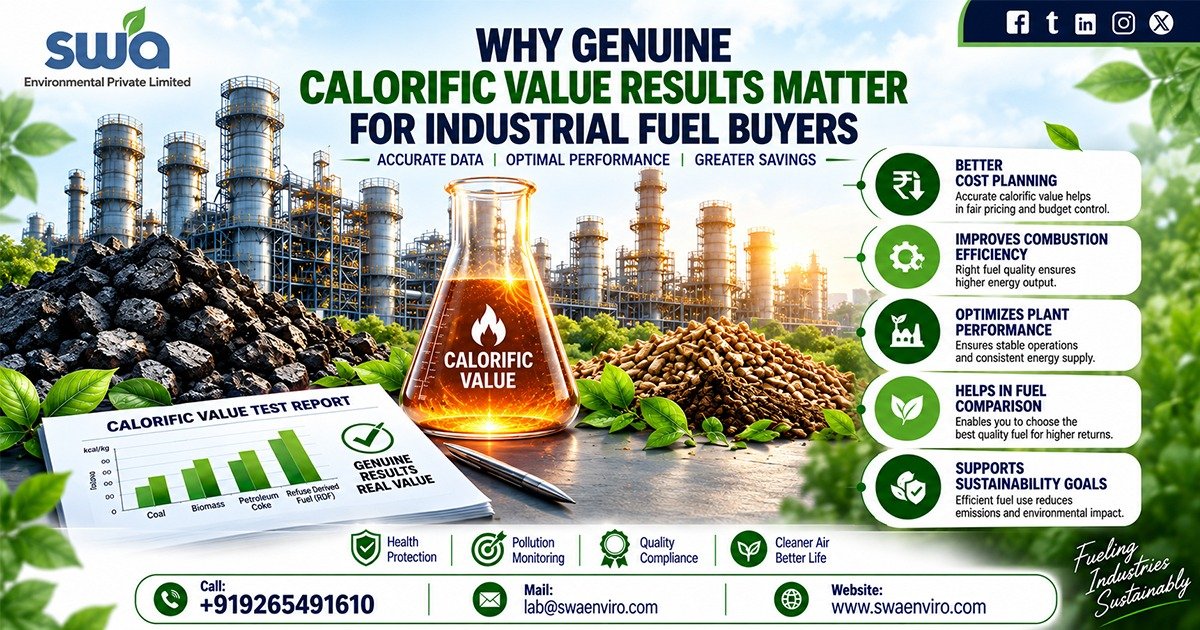
Industrial fuel buyers need reliable data before approving alternative fuels, waste-derived fuels, biomass, coal, RDF, or other combustible materials.
Calorific value directly influences how much useful heat a fuel can deliver during combustion.
For industrial buyers, genuine calorific value results are important because they support accurate fuel comparison, combustion planning, cost estimation, quality control, and purchasing decisions.
Calorific value is the amount of heat released when a specific quantity of fuel undergoes complete combustion.
It is commonly expressed as:
- MJ/kg
- kcal/kg
- BTU/lb, depending on the application and reporting requirement
Two commonly discussed measurements are:
- Gross Calorific Value (GCV): Includes the heat recovered from condensation of water vapour.
- Net Calorific Value (NCV): Excludes the latent heat associated with water vapour and can be more relevant for practical combustion applications.
The correct basis and testing method should always be clearly stated with the reported result.
Why Genuine Calorific Value Results Matter
1. Helps Buyers Compare Fuel Quality
A verified calorific value gives buyers a consistent basis for comparing different fuel sources.
Key benefits include:
- Comparing alternative fuel suppliers
- Evaluating different fuel batches
- Checking whether fuel meets purchase specifications
- Understanding energy delivered per unit of fuel
2. Supports Accurate Fuel Cost Calculations
Buying fuel based only on price per tonne can produce misleading comparisons.
A fuel with a lower purchase price may deliver less usable energy. Genuine calorific value data helps buyers evaluate:
- Cost per tonne
- Energy available per tonne
- Approximate cost per unit of energy
- Fuel consumption requirements
This provides a more meaningful approach to industrial fuel procurement.
3. Improves Combustion Planning
Industrial boilers, furnaces, kilns, incinerators, and thermal systems depend on predictable fuel characteristics.
Reliable calorific value information can help technical teams assess:
- Expected heat release
- Fuel feeding requirements
- Combustion conditions
- Thermal load
- Potential fuel substitution requirements
4. Helps Identify Fuel Quality Variations
Fuel composition can change between batches because of moisture, ash, organic content, processing conditions, or source materials.
Regular calorific value testing can help identify:
- Batch-to-batch variation
- Unexpected energy reduction
- Supplier quality inconsistencies
- Changes in fuel composition
- Potential blending requirements
5. Supports Supplier Verification
Industrial buyers often need to verify whether supplied fuel matches agreed specifications.
Independent and properly conducted calorific value testing can provide useful evidence for:
- Supplier qualification
- Incoming material inspection
- Contract compliance
- Quality documentation
- Fuel acceptance decisions
6. Reduces Procurement Uncertainty
Genuine test results give procurement and technical teams measurable information instead of relying entirely on supplier declarations.
This can improve communication between:
- Purchase teams
- Quality-control departments
- Laboratory personnel
- Production managers
- Fuel suppliers
Why Sample Preparation and Testing Matter
A calorific value result is only meaningful when the sample represents the material being evaluated and the test follows an appropriate method.
Important factors include:
- Representative sampling
- Proper sample preparation
- Moisture determination
- Suitable laboratory equipment
- Correct test procedure
- Accurate result reporting
- Clear identification of testing basis
For heterogeneous fuels such as waste-derived materials, proper sampling becomes especially important because composition may vary considerably within the same consignment.
Important Factors That Can Affect Calorific Value
Several fuel characteristics can influence the reported energy value:
- Moisture: Higher moisture generally reduces the useful energy available during combustion.
- Ash: Non-combustible material contributes little or no combustion energy.
- Organic content: Combustible components influence overall energy release.
- Fuel composition: Different materials have different inherent energy values.
- Particle characteristics: Physical properties can affect handling and combustion behaviour.
- Testing basis: As-received, air-dried, dry, GCV, and NCV values are not directly interchangeable.
GCV vs NCV: Why Buyers Should Check the Basis
Buyers should not compare two calorific value figures without confirming their reporting basis.
| Parameter | Meaning | Buyer Consideration |
|---|---|---|
| GCV | Includes condensation heat of water vapour | Useful for specific laboratory and fuel comparison applications |
| NCV | Excludes condensation heat | Often useful for practical energy assessment |
| As-received basis | Represents fuel in its received condition | Useful for actual incoming fuel evaluation |
| Dry basis | Calculated after excluding moisture | Useful for composition comparison |
The testing report should clearly identify the value, unit, basis, sample identity, and applicable test method.
How SWA Environmental Private Limited Supports Reliable Fuel Evaluation
SWA Environmental Private Limited can support industrial fuel buyers seeking dependable calorific value information for fuel quality and energy assessment.
A professional testing approach can help businesses:
- Evaluate incoming fuel samples
- Compare alternative fuel materials
- Understand energy characteristics
- Monitor fuel quality
- Support supplier evaluation
- Generate documented test results
- Make data-driven fuel procurement decisions
Industries That Can Benefit
Genuine calorific value testing can be relevant to businesses handling:
- Cement and clinker production
- Thermal power applications
- Industrial boilers
- Foundries and furnaces
- Waste-to-energy operations
- RDF and SRF processing
- Biomass fuel applications
- Chemical manufacturing
- Paper and textile industries
- Process heating systems
What Should Buyers Check in a Calorific Value Report?
Before using a result for procurement or technical evaluation, buyers should verify:
- Sample identification
- Testing date
- Calorific value
- Measurement unit
- Testing basis
- Moisture information
- Applicable testing method
- Laboratory details
- Relevant observations or limitations
FAQs
2. Why is calorific value important for fuel buyers?
It helps buyers compare energy content, evaluate fuel quality, and estimate energy-related procurement costs.
3. What is the difference between GCV and NCV?
GCV includes condensation heat from water vapour, while NCV excludes this latent heat.
4. Does moisture affect calorific value?
Yes. Higher moisture generally reduces the useful energy available from a given quantity of fuel.
5. Can calorific value vary between fuel batches?
Yes. Changes in moisture, composition, ash, and source materials can cause batch-to-batch variation.
6. Why should buyers use genuine test results?
Reliable laboratory results provide measurable information for fuel comparison, quality monitoring, supplier evaluation, and procurement decisions.
Choose Genuine Calorific Value Testing
Choose genuine calorific value testing to verify fuel quality, improve purchasing confidence, and support efficient industrial operations.
Website: www.swaenviro.com
Phone: +919265491610
Email: lab@swaenviro.com