
Firstly, understand the technologies and key features and advance technologies in elemental analysis till 2026 So apart from conventional methods the elemental analysis is carried out as follows
- ICP-MS (Inductively Coupled Plasma Mass Spectrometry)
- ICP-OES (Inductively Coupled Plasma Optical Emission Spectroscopy)
- Atomic Absorption Spectroscopy (AAS)
1. The basic understanding of the Spectroscopy for elementary measurement
| Parameter | AAS (Flame / GFAAS) |
ICP-OES (Optical Emission) |
ICP-MS (Single Quad) |
ICP-MS/MS (Triple Quad / QQQ) |
|---|---|---|---|---|
| Working Principle | The sample is atomized using a flame or graphite furnace, and a light beam specific to a particular metal passes through it. The amount of light absorbed indicates the concentration of that element. | Samples are introduced into a high-temperature plasma (around 10,000 K). Elements emit characteristic light wavelengths, and the emitted intensity is measured. | The plasma ionizes the elements, and a single quadrupole mass spectrometer separates the resulting ions based on their raw mass-to-charge ratio. A helium collision cell is used to physically slow down and filter out larger, unwanted molecular interferences. | The plasma ionizes the elements, and a tandem sequence of two mass filters split by a chemical reaction cell isolates the target element. It uses active reactive gases to chemically shift the target element’s mass weight mid-flight, completely bypassing overlapping matrix interferences. |
| Schematic Diagram |
|
 |
  |
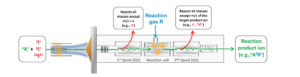 |
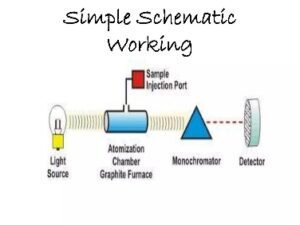
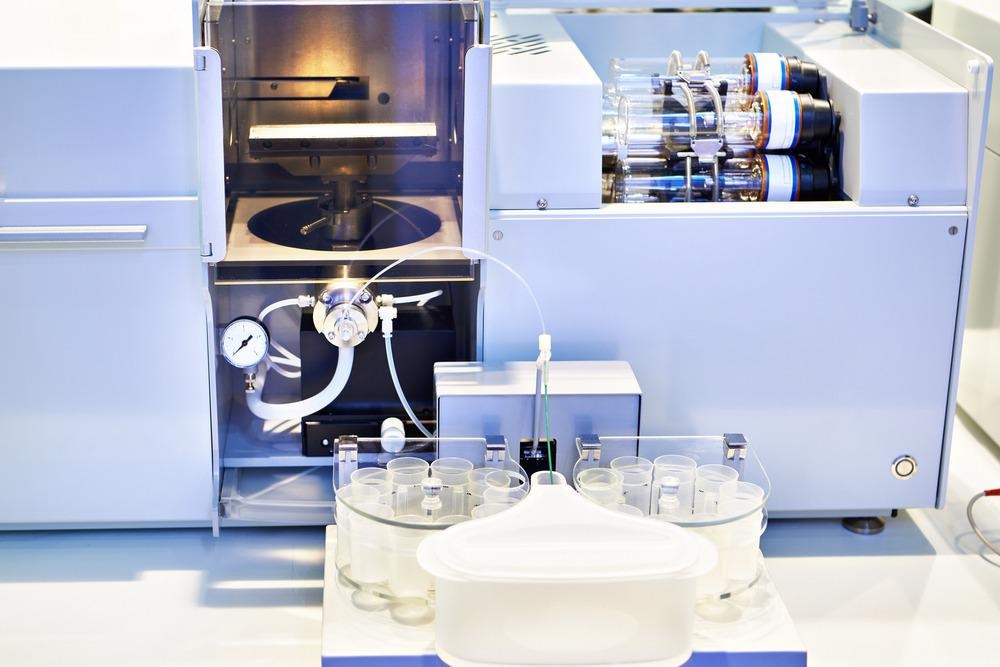
Image showing a picture of AAS (Atomic Absorption Spectroscopy)
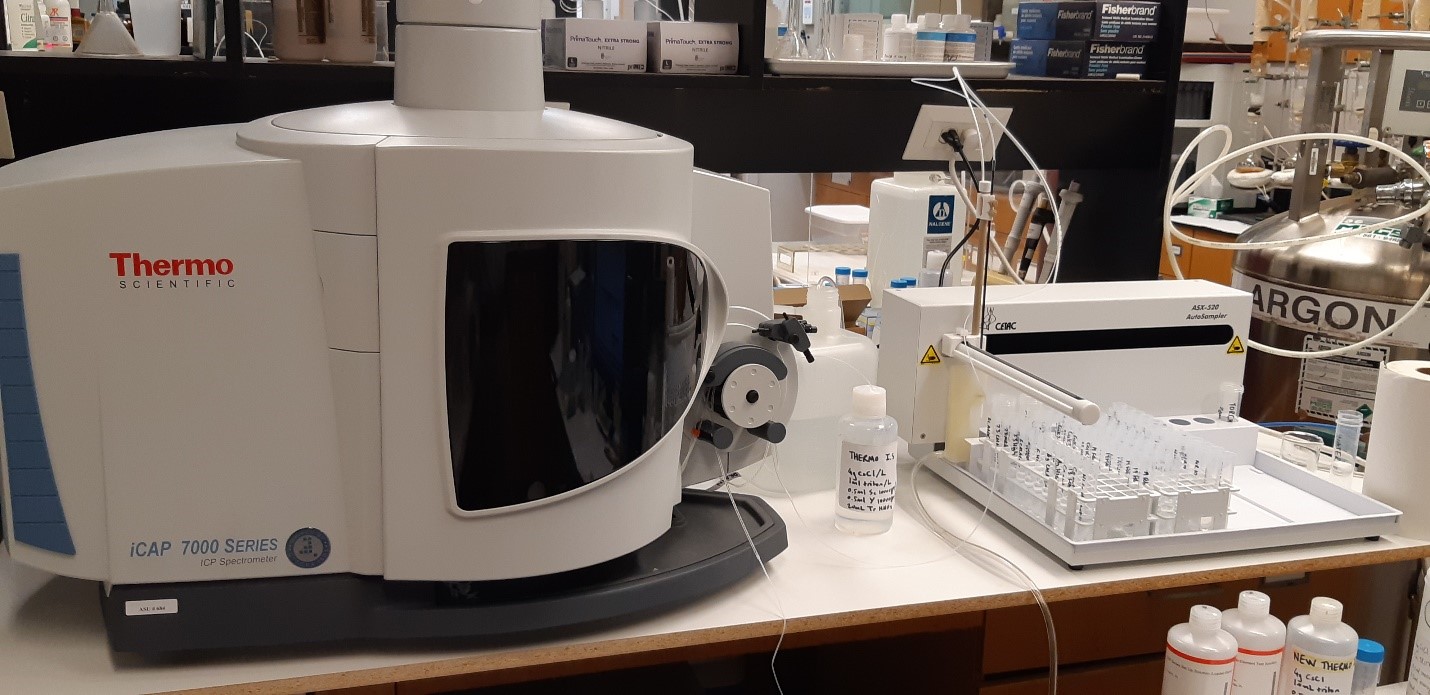
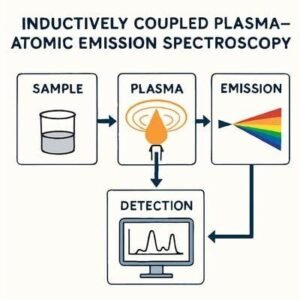
Image showing a picture of ICP-OES (Inductively Coupled Plasma – Optical Emission Spectroscopy)
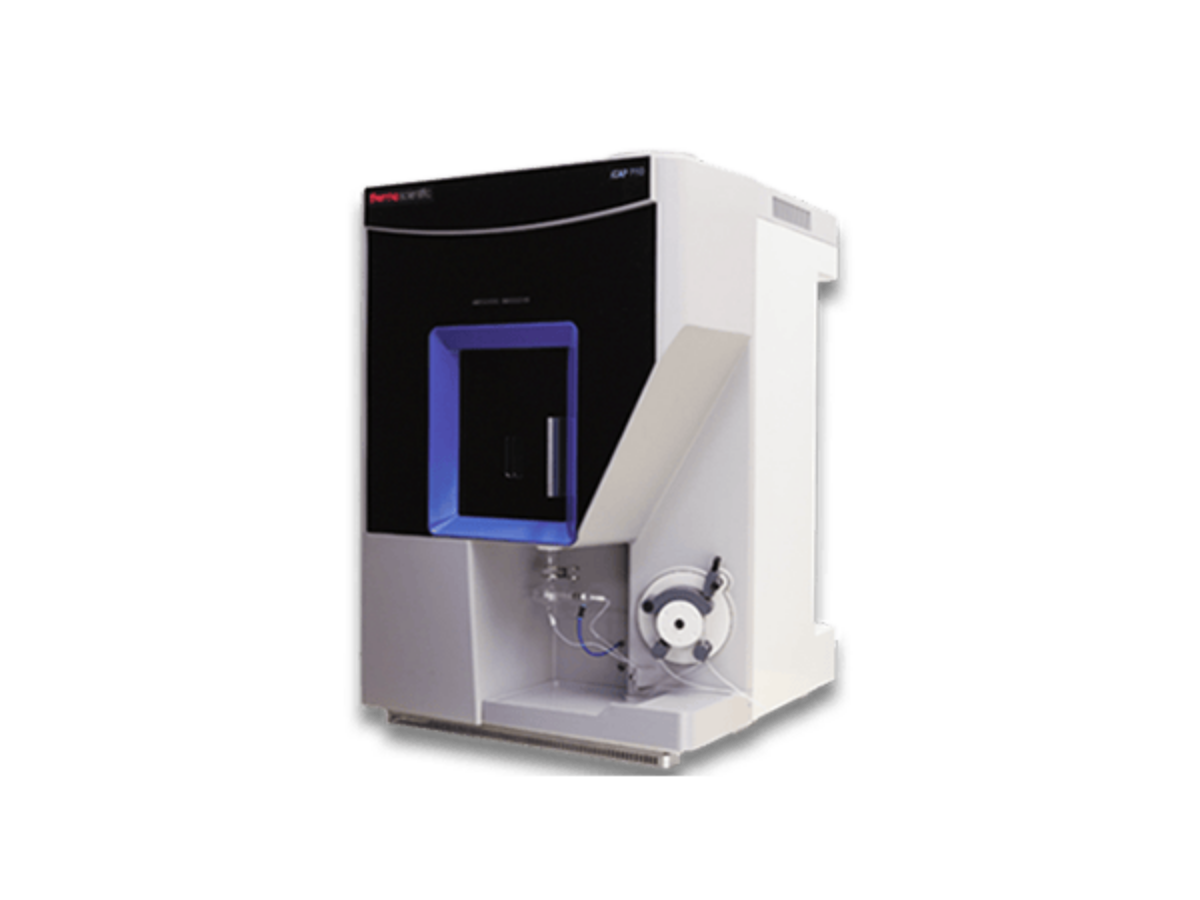
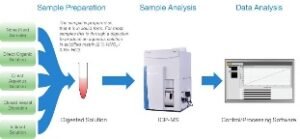
Image showing a picture of ICP-MS (Inductively Coupled Plasma – Mass Spectrometry)
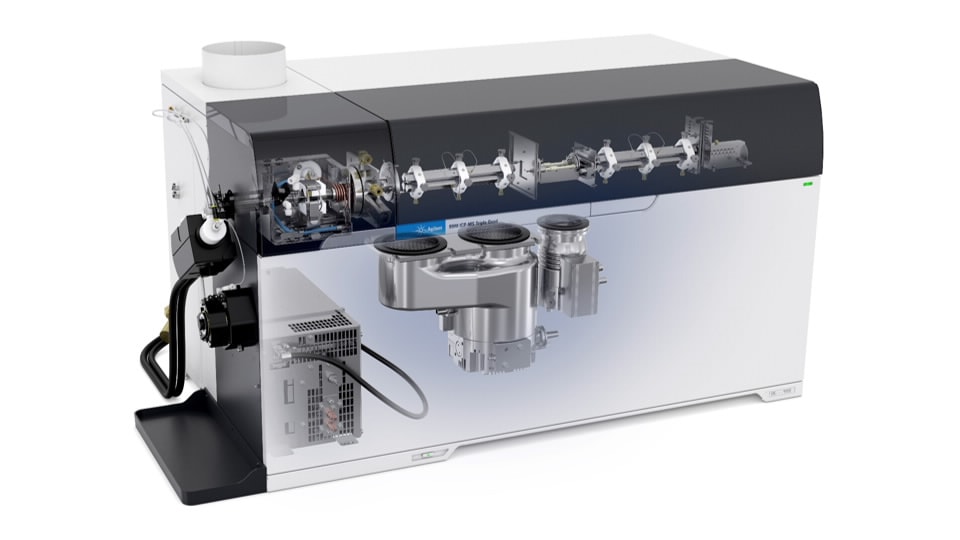
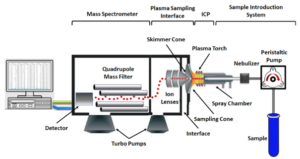
Image showing isometric section of ICP MS/MS (Inductively Coupled Plasma – Tandem Mass Spectrometry)
So every time you confuse for the purchase which instrument I should by, see there is no best option but yes every time you have to choose the instrument as per your requirement and uses of the instrument, so Each technology has its own strengths, limitations, cost considerations, and ideal applications. Here , you can compare the technology vs application
2. The Master Instrumental Selection Matrix
| Parameter | AAS (Flame / GFAAS) |
ICP-OES (Optical Emission) |
ICP-MS (Single Quad) |
ICP-MS/MS (Triple Quad / QQQ) |
|---|---|---|---|---|
| Multi-Element Capability | Very Limited Sequential; tests 1 element at a time (up to 6–8 with automated lamps). |
Excellent Simultaneous; captures up to 74 elements in under a minute. |
Excellent Simultaneous & rapid scanning; captures 80+ elements & isotopic data. |
Ultimate Simultaneous mass scanning; unlocks difficult light elements (e.g., Fluorine). |
| Detection Limits | Flame: ppm (mg/L) GFAAS: ppb (ug/L) |
ppb (ug/L) to ppm Highly dependable for mid-to-high concentrations. |
ppt (ng/L) to sub-ppt The benchmark for trace elements. |
Sub-ppt to ppq (Parts-per-quadrillion); maximum sensitivity possible. |
| Linear Dynamic Range | Narrow Flame: 10^3 GFAAS: 10^2 |
Wide 10^6 – 10^7 Measures trace & major levels in one run. |
Very Wide 10^8 – 10^9 Handles ppt to hundreds of ppm natively. |
Massive Up to 10^11 orders of magnitude in modern systems. |
| Sample Throughput | Slow Flame is rapid per element; GFAAS requires 2–3 minutes per sample. |
Highest Can easily process 2,000+ samples/day regardless of element count. |
Fast Processes approx. 1,200 samples/day for complete elemental panels. |
Moderate to Fast Slightly slower than Single Quad if multi-gas switching is active. |
| Matrix Tolerance (TDS Limit) |
Flame: High (up to 10%) GFAAS: Low (<1%) |
Outstanding Handles up to 30% TDS directly; robust for heavy brines/wastewater. |
Low Prefers <0.2% TDS directly. Needs inline aerosol/gas dilution hardware. |
Moderate to High Tandem architecture weeds out matrix noise; handles complex matrices cleanly via gas dilution. |
| Interference Handling | Minimal Chemical/physical interferences are rare and easily managed. |
High (Spectral) Overlapping wavelength lines. Corrected via high-resolution optics or software. |
Moderate to High Polyatomic overlaps (e.g., 40Ar16O+ blinding 56Fe). Handled by Helium collision mode. |
Eliminated Uses tandem mass filtering (Q1 -> Cell -> Q2) to isolate and clear severe overlaps. |
| Capital Investment (Initial Cost) |
Low 10 to 25 lacs |
Medium 30-50 lacs |
High 80 – 95 Lacs |
Very High 1.2 – 1.5 cr |
| Operational & Maintenance Costs | Low Standard combustion gases (Air/Acetylene/Nitrus oxide ), targeted lamps. |
Moderate High consumption of analytical-grade Argon gas. |
High High-purity Argon, collision gas, consumable cones, vacuum pumps. |
Extremely High Multiple high-purity reaction gases, dual quadrupoles, ultra-pure cleanroom reagents. |
| Operator Skill Level | Routine / Low Ideal for junior lab technicians or simple QA workflows. |
Moderate Simple routine operation once automated methods are configured. |
High Requires expert understanding of mass spectra, matrices, and blank control. |
Expert / Specialist Requires dedicated specialists to manage ion-molecule chemistry and method design. |
3. Analytical Performance Specifications
| Analytical Parameter | Flame AAS | Graphite Furnace AAS (GFAAS) | ICP-OES | ICP-MS (Single Quad) | ICP-MS/MS (Triple Quad) |
|---|---|---|---|---|---|
| Typical Quantification Limit | Parts-per-million (mg/L) |
Parts-per-billion (ug/L) |
Mid-to-high ppb (>10 ug/L) |
Parts-per-trillion (ng/L) |
Parts-per-quadrillion (pg/L or fg/L) |
| Sample Volume Required | High (2.0 to 5.0 mL per run) |
Minimal (10 to 50 uL per injection) |
Moderate (1.5 to 3.0 mL per run) |
Low-to-Moderate (1.0 to 2.0 mL per run) |
Low-to-Moderate (1.0 to 2.0 mL per run) |
| Elements Excluded / Blind | Cannot measure non-metals, halogens, or refractory elements (U, Th, Zr, B, S, P).
Needs to confirm the range of detection for each element with the manufacturer – Quantification limit is vary make to make / Model – Model |
Same as Flame AAS; cannot measure volatile elements easily due to pre-heating smoke-out.
Needs to confirm the range of detection for each element with the manufacturer – Quantification limit is vary make to make / Model – Model |
Cannot measure Fluorine or noble gases. Poor sensitivity for Mercury (Hg) without cold vapor kit. | Struggles heavily with C, N, O, F, H. Poor limits for S, P, Si, and Cl. | Unlocks all elements. Can accurately resolve S, P, Si, F, and Cl using reactive mass-shifting. |
| Isotopic Analysis | No | No | No | Yes (Measures isotopic abundance and ratios) |
Yes (Highest precision isotopic branching ratio measurement) |
| Calibration Stability | Short (Drifts within 2–4 hours; requires frequent recalibration) |
Moderate (Graphite tube degradation alters curve every 100 burns) |
Excellent (Stable for 8–12 hours continuous run without recalibration) |
Moderate (Cone coating requires recalibration or standards every 4–6 hours) |
Moderate-to-High (Advanced electronics stabilize drift, but active matrix matching mandatory) |
4. Total Dissolved Solids (TDS) Matrix Tolerances & Limitations
Total Dissolved Solids (TDS) represents the sum of all inorganic and organic substances contained in a liquid. In elemental spectroscopy, high TDS alters physical aerosol formation, plasma thermal kinetics, and mass-spectrometric extraction. The matrix limits below define the operational boundaries between routine operation and systematic instrument failure.
| Instrument Type | Max Practical TDS Limit | Physical Failure Point | Analytical Consequence | High-TDS Workaround / Accessory |
|---|---|---|---|---|
| Flame AAS | Up to 10% (Highly Tolerant) |
Burner Head Slot: Salt crusts bake onto the long metal burner opening. |
Severe Light Scattering: Salt particles block light beams, causing false high absorption readings. |
Deuterium or Zeeman background correction; regular manual scraping with razor blades. |
| Graphite Furnace AAS (GFAAS) | < 0.2% (Extremely Vulnerable) |
Pyrolytic Coating: High salt concentrations strip the tube’s protective layer. |
Smoke Blinding: Thick molecular vapor clouds block optical light path entirely. |
Matrix Modifiers (e.g., Ammonium Nitrate) to volatilize NaCl matrix at low temps. |
| ICP-OES | Up to 30% (High Matrix Leader) |
Standard Nebulizer: Concentric tips clog at >1% TDS; Torch quartz degradation. |
Vitrification: Salt accumulations freeze onto quartz outer tube, cracking under high heat. |
Switch to V-Groove or Argon Mist nebulizer; use Sheath Gas and Radial viewing mode. |
| ICP-MS (Single Quad) | < 0.2% (High Vulnerability) |
Interface Cones: Deposits close up Sampler (1.0mm) and Skimmer (0.4mm) holes. |
Orifice Clogging & Drift: Salt bridges across cone holes, degrading vacuum and blocking the ion beam. |
Aerosol/Gas Dilution (inline Argon gas injection); automated liquid micro-dilutions. |
| ICP-MS/MS (Triple Quad) | < 0.5% (Moderate Vulnerability) |
Interface Cones & Extraction Lenses. | Space-Charge Effects: Heavy matrix ions suppress signal transmission for light isotopes. |
Discrete sampling switching valves; automated high-matrix introduction hardware. |
5. Infrastructure, Gases, & Hidden Operational Costs
| Operational Parameter | Flame AAS | Graphite Furnace AAS (GFAAS) | ICP-OES | ICP-MS (Single Quad) | ICP-MS/MS (Triple Quad) |
|---|---|---|---|---|---|
| Primary Gas & Consumption | Acetylene (C2H2): 2–4 L/min Compressed Air: 10 L/min Nitrous Oxide (N2O): 5–8 L/min |
Argon (Ar): <1.0 L/min (Intermittent purge flow during cooling/heating cycles) |
Argon (Ar): High (15 to 22 L/min continuously during operation) |
Argon (Ar): High (15 to 20 L/min continuously during operation) |
Argon (Ar): High (15 to 20 L/min continuously during operation) |
| Required Gas Purity Grade | Industrial/Welding Grade (99.0%) | High-Purity (99.99%) | Analytical Grade (99.995%) | Ultra-Pure Grade 5.0 (99.999%) | Ultra-Pure Grade 5.0 to 6.0 (99.999% – 99.9999%) |
| Secondary / Cell Gases | None | None | None | Helium (He) or Hydrogen (H2) for collision cell. | Aggressive gases: Oxygen (O2), Ammonia (NH3), or Methane (CH4). |
| Exhaust & HVAC Demands | Standard laboratory fume vent to clear soot/heat. | Low heat vent for graphite vapor extraction. | Dedicated, high-volume exhaust to extract intense plasma heat. | Dedicated exhaust system; room temperature must remain exceptionally stable (+/- 1 C). | Dual exhaust tracks; climate-controlled, dust-free enclosure recommended. |
| Instrument Warm-up Time | Instant (5–10 minutes lamp stabilization) |
Short (10–15 minutes) |
Moderate (30 minutes for optical bench thermal equilibrium) |
Long (30–45 minutes to stabilize deep vacuum state) |
Longest (60+ minutes to establish high-vacuum zones across both quadrupoles) |
First thing is what are ranges required to measure the products
- As all instruments are having different types of ranges and yes make wise ranges may vary
- If you want ultra trace level range – ppb or ppt, medium ranges ppm, or higher concentration its
There is no universal “best” technology among AAS, ICP-OES, and ICP-MS.
Each technique is designed for a different level of:
- Sensitivity
- Accuracy
- Speed
- Cost
- Application complexity
The key is choosing the right tool for the right purpose.
Because in analytical science:
…..” The final verdict”
AAS is a good option if you are a new lab learning the ropes, while ICP OES is a better option if you anticipate growing and are willing to accept a little more risk.
Compared to ICP OES, ICP MS offers more precision and breakdown-free operation, requiring less troubleshooting.
Go for ICP MS if you can do the most advanced analysis.
Contact SWA Environmental Private Limited for selection of best suitable technology for your elemental analysis.
Website: www.swaenviro.com
Phone: +919265491610
Email: lab@swaenviro.com
View Service: Click here