Introduction to GCV and NCV
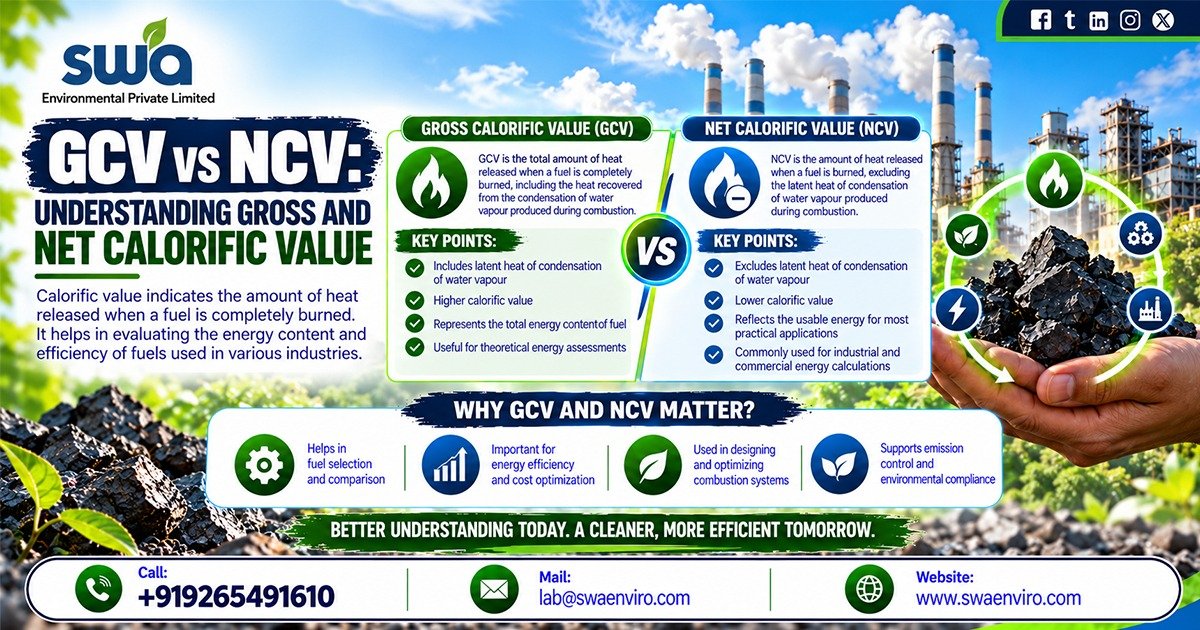
Gross Calorific Value (GCV) and Net Calorific Value (NCV) are two important measurements used to determine the energy content of fuels.
These values help industries understand how much heat a fuel can release during combustion and evaluate its energy efficiency.
SWA Environmental Private Limited explains the importance of GCV and NCV in fuel quality assessment, energy management, environmental monitoring, and industrial combustion applications.
Understanding the difference between Gross Calorific Value and Net Calorific Value helps industries select suitable fuels, improve combustion efficiency, and make informed operational decisions.
What Is Gross Calorific Value (GCV)?
Gross Calorific Value (GCV), also known as Higher Heating Value (HHV), measures the total heat released when a specific quantity of fuel undergoes complete combustion.
Key Features of GCV
-
Includes Condensation Heat: GCV accounts for the heat recovered when water vapour produced during combustion condenses into liquid water.
-
Measures Total Energy: It represents the maximum theoretical heat energy available from a fuel.
-
Fuel Quality Assessment: Industries use GCV to compare the energy potential of coal, biomass, petroleum products, and other fuels.
-
Industrial Applications: Power plants, boilers, cement industries, and manufacturing facilities use GCV measurements for fuel evaluation and energy calculations.
What Is Net Calorific Value (NCV)?
Net Calorific Value (NCV), also called Lower Heating Value (LHV), measures the usable heat released during complete fuel combustion without recovering the latent heat of water vapour condensation.
Key Features of NCV
-
Excludes Condensation Heat: NCV does not include the heat contained in water vapour leaving the combustion system.
-
Represents Available Heat: It indicates the energy available when combustion products release moisture as vapour.
-
Operational Efficiency: Industries use NCV to estimate fuel energy performance under operating conditions where exhaust moisture remains in vapour form.
-
Practical Applications: NCV supports boiler performance assessments, thermal energy calculations, fuel consumption planning, and combustion system evaluation.
GCV vs NCV: Key Differences
Understanding GCV vs NCV helps engineers, energy managers, and industrial buyers interpret fuel energy values correctly.
| Comparison Parameter | GCV (Gross Calorific Value) | NCV (Net Calorific Value) |
|---|---|---|
| Alternative Name | Higher Heating Value (HHV) | Lower Heating Value (LHV) |
| Heat Measurement | Total heat released | Heat available without condensation recovery |
| Water Vapour | Includes condensation heat | Excludes condensation heat |
| Energy Value | Higher | Lower |
| Measurement Purpose | Total fuel energy assessment | Practical fuel energy assessment |
| Applications | Fuel testing and energy evaluation | Boiler and combustion performance calculations |
Key Difference: GCV includes the latent heat recovered from water vapour condensation, whereas NCV excludes this heat.
Relationship Between GCV and NCV
GCV and NCV are closely related because both measure the energy released during fuel combustion. However, their values differ because of the treatment of water vapour produced during combustion.
General Relationship
The exact difference depends on the fuel’s hydrogen content, moisture content, and the reference conditions used for measurement.
For accurate comparisons, industries should ensure that both values use consistent units, fuel conditions, and calculation methods.
Why Are GCV and NCV Important in Industrial Applications?
Industries depend on accurate calorific value measurements to understand fuel performance and manage energy consumption.
1. Fuel Quality Evaluation
-
Determines the energy potential of different fuels.
-
Helps compare coal, biomass, RDF, and other combustible materials.
-
Supports fuel procurement and quality control decisions.
2. Boiler and Furnace Performance
-
Helps estimate the thermal energy available from fuel.
-
Supports boiler efficiency and heat balance calculations.
-
Assists engineers in evaluating combustion performance.
3. Energy Cost Management
-
Helps industries compare fuels based on their energy content.
-
Supports fuel consumption planning and operational budgeting.
-
Improves energy purchasing decisions.
4. Environmental and Waste Management
-
Supports the evaluation of refuse-derived fuel (RDF) and biomass.
-
Helps assess the energy potential of combustible waste.
-
Provides useful information for waste-to-energy project planning.
5. Industrial Process Optimization
-
Helps determine suitable fuel combinations.
-
Supports thermal process monitoring.
-
Assists industries in improving energy utilization.
How Are GCV and NCV Measured?
Industries commonly determine Gross Calorific Value using a bomb calorimeter.
Basic GCV Measurement Process
-
Sample Preparation: Prepare a representative fuel sample for testing.
-
Sample Weighing: Measure the required quantity accurately.
-
Combustion: Burn the sample inside a sealed oxygen-filled calorimeter under controlled conditions.
-
Heat Measurement: Measure the temperature increase in the surrounding calorimeter water.
-
GCV Calculation: Calculate the gross calorific value using the measured heat and appropriate corrections.
-
NCV Calculation: Determine NCV from GCV by accounting for the latent heat associated with water vapour.
Accurate results depend on proper sampling, instrument calibration, testing procedures, and applicable standards.
Factors Affecting GCV and NCV
Several fuel characteristics influence calorific value measurements.
Major Factors Affecting Calorific Values
-
Moisture Content: Higher moisture generally reduces the available energy per unit mass of fuel.
-
Hydrogen Content: Hydrogen contributes to water formation during combustion and influences the difference between GCV and NCV.
-
Carbon Content: Carbon contributes significantly to the heat released during combustion.
-
Ash Content: Non-combustible material reduces the energy available per unit mass of fuel.
-
Fuel Composition: Different proportions of combustible elements affect overall calorific value.
-
Sample Quality: Representative sampling and proper preparation help ensure reliable test results.
GCV and NCV Testing Support by SWA Environmental Private Limited
SWA Environmental Private Limited focuses on environmental and industrial testing solutions that support informed technical and operational decisions.
Understanding calorific values is important for organizations involved in fuel evaluation, waste management, combustion processes, and energy utilization.
Benefits of Accurate GCV and NCV Assessment
-
Evaluate the energy potential of combustible materials.
-
Understand fuel quality and composition.
-
Support industrial fuel selection.
-
Assess biomass and waste-derived fuel suitability.
-
Make informed energy management decisions.
-
Improve fuel monitoring and quality assessment practices.
For reliable fuel evaluation, industries should follow applicable testing standards and use appropriate laboratory methods.
Industries That Use GCV and NCV Analysis
GCV and NCV measurements provide valuable information across several industrial sectors.
Major Industrial Applications
-
Power Generation Plants: Evaluate coal and alternative fuel energy content.
-
Cement Manufacturing: Assess the calorific value of fuels used in kilns.
-
Waste-to-Energy Facilities: Determine the energy potential of combustible municipal and industrial waste.
-
Biomass Industries: Evaluate agricultural residues and biomass fuels.
-
Steel and Metal Industries: Support fuel quality assessment for thermal operations.
-
Chemical and Process Industries: Monitor fuel energy characteristics for industrial heating applications.
Conclusion: Choose the Right Calorific Value for Better Energy Assessment
GCV and NCV provide essential information about fuel energy content, combustion characteristics, and industrial energy utilization. While GCV represents the total heat released, NCV indicates the heat available without recovering water vapour condensation energy.
Understanding these measurements enables industries to evaluate fuel quality, compare energy sources, and make better operational decisions.
SWA Environmental Private Limited supports informed environmental and industrial assessment by highlighting the importance of accurate fuel analysis and reliable testing practices.
Frequently Asked Questions
Q1: What Is the Main Difference Between GCV and NCV?
GCV includes the latent heat of condensed water vapour, whereas NCV excludes this heat from the fuel energy value.
Q2: Which Is Higher, GCV or NCV?
GCV is higher than NCV because it includes the additional heat recovered through water vapour condensation.
Q3: Which Instrument Measures Gross Calorific Value?
A bomb calorimeter commonly measures GCV by determining the heat released during complete combustion of a fuel sample.
Q4: Why Are GCV and NCV Important for Industries?
They help industries evaluate fuel quality, calculate energy potential, compare fuels, manage combustion processes, and improve energy planning.
Q5: How Is Net Calorific Value Calculated?
Industries calculate NCV by subtracting the latent heat associated with water vapour from the Gross Calorific Value.
Q6: Which Industries Require GCV and NCV Testing?
Power plants, cement manufacturers, biomass industries, waste-to-energy facilities, steel plants, and chemical industries use calorific value analysis.
GCV vs NCV: Understanding Gross and Net Calorific Service in Gujarat and Rajasthan
SWA Environmental Private Limited offers Environmental Noise Monitoring Services in Gujarat and Rajasthan, covering the following locations.
Service Locations in Gujarat
Ahmedabad, Surat, Vadodara, Rajkot, Bhavnagar, Jamnagar, Anand, Gandhinagar, Bharuch, Morbi, Vapi, Valsad, Junagadh, Nadiad, Mehsana, Porbandar, Godhra, Navsari, Surendranagar, Patan, Amreli, Palanpur, Modasa, Dahod, Gandhidham, Bhuj, Ankleshwar, Kalol, Sanand, Halol, Kadi, Khambhat, Jetpur, Kutch, Mundra, Rajpipla, Dwarka, Dholka, Bhachau, Chotila, Dhandhuka, Umargam, Padra, Jhagadia, Savli, Sachin, Palghar, Vallabh Vidyanagar, Mandvi, Halvad, Balasinor, Nandesari, Pardi, Karamsad.
Service Locations in Rajasthan
Jaipur, Jodhpur, Pali, Tonk, Udaipur, Alwar, Sikar, Balotra, Bikaner, Ajmer, Kota, Sri Ganganagar, Bhilwara, Banswara, Bharatpur, Baran, Beawar, Bhiwadi, Hanumangarh, Dholpur, Pratapgarh, Dungarpur, Jaisalmer, Hindaun, Bundi, Chittorgarh, Kishangarh, Sujangarh, Sawai Madhopur, Pushkar, Churu.
Contact SWA Environmental Private Limited
Contact SWA Environmental Private Limited today for reliable environmental testing insights and smarter industrial fuel quality assessment solutions.
-
Website: www.swaenviro.com
-
Phone: +91 9265491610
-
Email: lab@swaenviro.com