
SWA Environmental Pvt. Ltd. offers comprehensive pesticide residue testing services for water, soil, and waste across Gujarat.
Our registered office, manufacturing facility, and laboratory are based in Ahmedabad and Jaipur, India.
We ensure full compliance with regulatory standards, including EPA, CPCB, and MOEF&CC guidelines, through NABL-accredited pesticide residue testing.
Testing Methods and Capabilities:
- GC-FID/NPD/ECD Analysis for pesticide residue detection in water, soil, solid waste, and hazardous waste monitoring.
- Advanced instrumentation for accurate and sensitive detection of pesticide residues in environmental matrices.
Importance of Pesticide Residue Monitoring in the Environment
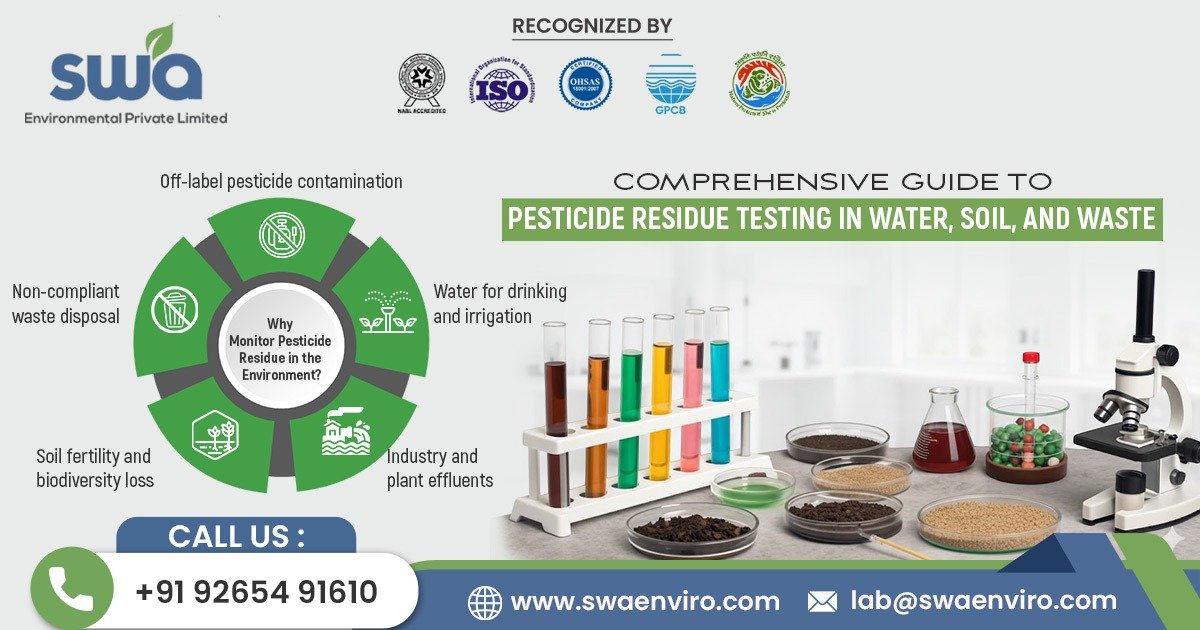
Pesticides are toxic to human health and ecosystems when they leach into water, soil, and waste streams. Unmonitored pesticide residues can contaminate the following:
- Groundwater & Surface Water: Essential for drinking and irrigation.
- Wastewater & Effluents: Discharged from industries and treatment plants.
- Agricultural & Forest Soil: Affects fertility and biodiversity.
- Hazardous & Solid Waste: Results in non-compliant disposal practices.
- Pesticide Products: Leads to off-label contamination.
Pesticides, often persistent organic pollutants (POPs), can have long-term toxic effects and bioaccumulate in the environment.
Types of Pesticides Detected in Environmental Samples
Understanding pesticide families in industrial/agricultural settings is essential for selecting the correct testing method:
- Organochlorine Pesticides (OCPs):
- Examples: DDT, Endosulfan, Aldrin, Lindane
- Properties: Persistent, bioaccumulative, banned/restricted in many countries
- Detection Method: GC-ECD (Electron Capture Detector)
- Organophosphate Pesticides (OPPs):
- Examples: Malathion, Parathion, Chlorpyrifos
- Properties: Widely used, less persistent but acutely toxic
- Detection Method: GC-NPD, GC-FID
- Carbamate Pesticides:
- Examples: Carbaryl, Aldicarb
- Properties: Short environmental half-life
- Detection Method: GC-FID, LC techniques
- Synthetic Pyrethroids:
- Examples: Cypermethrin, Permethrin
- Properties: Low human toxicity, highly toxic to aquatic life
- Detection Method: GC-FID/ECD
- Herbicides & Fungicides:
- Examples: Atrazine, 2,4-D, Mancozeb
- Properties: Common in agriculture, can leach into water and soil
- Detection Method: GC-FID, LC-MS/MS (when required)
By identifying pesticide classes, we can select appropriate testing methods to meet regulatory limits.
Regulatory Framework in India
SWA Enviro adheres to the following regulatory standards:
- EPA (Environmental Protection Act) 1986
- CPCB & SPCB Consent Conditions
- MoEF&CC Guidelines for EIA & Waste Authorization
- ISO/IEC 17025:2017 NABL Accreditation
Sectors Requiring Pesticide Residue Testing
- Agrochemical and Fertilizer Industries
- Pesticide Formulation & Repackaging Units
- CETPs, STPs, and ETPs
- Landfill & Incineration Plants
- Agricultural Land & Irrigation Systems
- Hazardous Waste Treatment Facilities
Sample Matrices Analyzed
We test a wide range of environmental samples to ensure comprehensive analysis:
- Water: Drinking, surface, and groundwater
- Wastewater: Industrial effluent and treated wastewater
- Soil: Agricultural land, plantation, and wetland areas
- Solid Waste: Compost, biosolids, sludge, hazardous waste
- Pesticide Products: Products and intermediates
Each sample is processed under strict quality control and chain-of-custody protocols.
Advanced Pesticide Testing Methods – GC with FID/NPD/ECD
We employ state-of-the-art Gas Chromatography (GC) methods for precise pesticide analysis:
- GC-FID (Flame Ionization Detector): Ideal for organophosphate and carbamate pesticides in hydrocarbon-rich samples like water and wastewater.
- GC-NPD (Nitrogen Phosphorus Detector): Highly selective for nitrogen- and phosphorus-based compounds, ideal for organophosphates like Malathion and Chlorpyrifos.
- GC-ECD (Electron Capture Detector): Extremely sensitive for detecting organochlorines (e.g., DDT, Endosulfan) at trace levels in water, soil, and waste.
All tests are performed under controlled QA/QC protocols approved by MOEF&CC.
SWA Enviro’s Unique Capabilities
What sets SWA Enviro apart in pesticide residue testing:
- NABL-accredited Lab (ISO/IEC 17025:2017)
- EPA & CPCB-approved Testing Methods
- Multi-detector GC Systems for versatile pesticide analysis
- Experienced Field Team for accurate on-site sample collection
- Pan-India Service Reach
- Regulatory Reporting Support for audit and clearance
We provide traceable, credible, and legally defensible results accepted by regulators, consultants, and clients across industries.
Service Locations in Gujarat
Our services extend across Gujarat, including major locations like:
- Ahmedabad, Surat, Vadodara, Rajkot, Bhavnagar, Jamnagar, Anand, Gandhinagar, Bharuch, Morbi, Vapi, Valsad, Junagadh, Nadiad, Mehsana, Porbandar,
Godhra, Navsari, Surendranagar, Patan, Amreli, Palanpur, Modasa, Dahod, Gandhidham, Bhuj, Ankleshwar, Kalol, Sanand, Halol, Kadi, Khambhat, Jetpur,
Kutch, Mundra, Morbi, Rajpipla, Dwarka, Dholka, Gandharpur, Bhachau, Chotila, Dhandhuka, Umargam, Padra, Jhagadia, Kalol, Savli, and many more.
Get in Touch — Let’s Ensure Compliance Together
For consultations, quotes, or long-term environmental monitoring contracts, SWA Environmental Pvt. Ltd. is your trusted partner for pesticide residue testing.
- Contact us: +91 9227988980
- Email: lab@swaenviro.com
- Visit: www.swaenviro.com