
Why Measuring Insertion Loss is Critical for CPCB Compliance, Worker Safety & Community Noise Control
Author:
Pankaj Gothi
COO – Laboratory Division
SWA Environmental Private Limited
Introduction
Diesel Generator (DG) sets are indispensable for industries, hospitals, commercial buildings, data centers, pharmaceutical plants, hotels, residential complexes, and infrastructure projects where uninterrupted power supply is essential.
However, while DG sets ensure operational continuity, they also generate one of the most significant environmental pollutants in industrial facilities—noise.
A typical diesel generator can produce sound pressure levels exceeding 95–115 dB(A) near the source, making it one of the loudest pieces of equipment in a facility.
Without effective noise control measures, excessive sound levels can:
- Affect employee health and hearing
- Disturb nearby communities
- Violate CPCB noise standards
- Increase the risk of legal action
- Delay environmental approvals
- Impact ESG and sustainability goals
To reduce this noise, modern DG sets are equipped with acoustic enclosures designed to attenuate sound before it reaches the surrounding environment.
But an important question remains:
How do you verify that an acoustic enclosure is actually performing as intended?
The answer lies in Insertion Loss (IL) Testing.
Insertion Loss is one of the most important acoustic performance indicators used to evaluate the effectiveness of diesel generator noise control systems.
What is Insertion Loss?
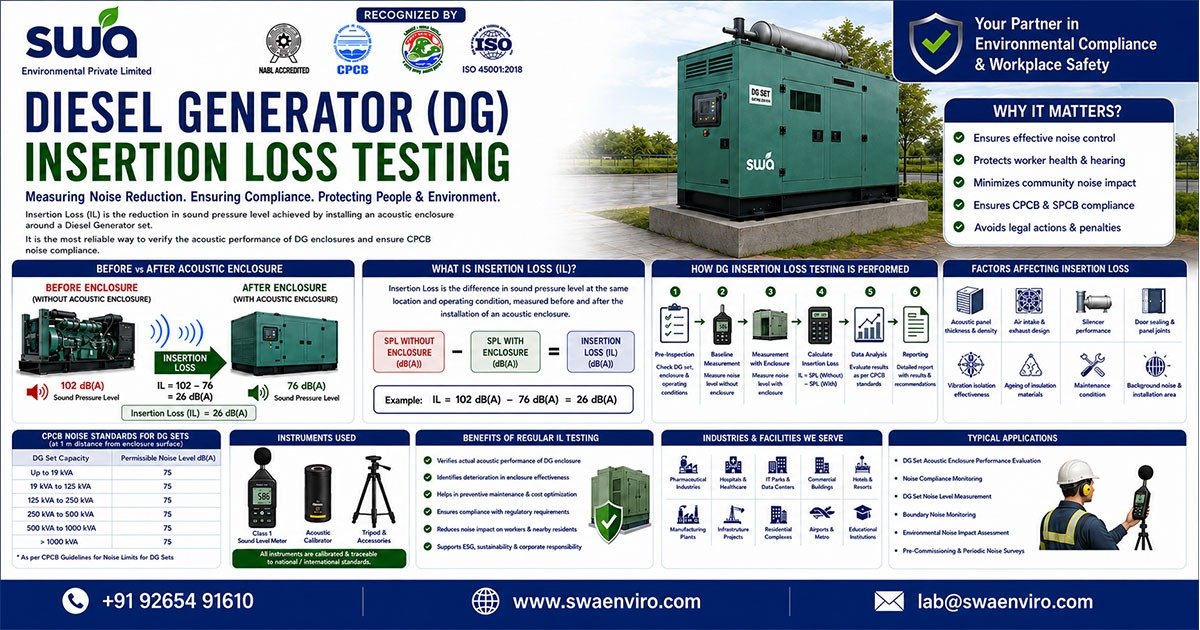
Insertion Loss (IL) is the reduction in sound pressure level achieved by installing a noise control device such as an acoustic enclosure, acoustic barrier, silencer, or soundproof housing.
In simple terms:
It tells us how much noise has been reduced because of the acoustic enclosure.
It is expressed in decibels [dB(A)].
Understanding Insertion Loss with a Practical Example
Imagine a DG set operating without an acoustic enclosure.
The measured sound pressure level at a specified distance is:
102 dB(A)
After installing the acoustic enclosure, the same measurement location records:
76 dB(A)
Insertion Loss equals:
102 – 76 = 26 dB(A)
This means the enclosure has reduced the generator noise by 26 decibels.
A higher insertion loss generally indicates better acoustic performance.
Why is DG Insertion Loss Testing Important?
Many industries assume that purchasing a “silent DG set” automatically guarantees regulatory compliance.
This assumption can be misleading.
The acoustic performance of a DG enclosure depends on several factors:
- Enclosure design
- Acoustic insulation quality
- Air inlet and outlet silencers
- Engine vibration isolation
- Cooling airflow openings
- Exhaust silencer performance
- Door sealing
- Maintenance condition
Over time, damaged insulation panels, loose doors, corroded silencers, or deteriorated sealing materials can significantly reduce the enclosure’s effectiveness.
Routine insertion loss testing verifies whether the enclosure continues to provide the expected level of noise attenuation.
Difference Between Noise Level Measurement and Insertion Loss
These two terms are often confused but serve different purposes.
| Parameter | Noise Level Measurement | Insertion Loss Measurement |
|---|---|---|
| Purpose | Measures existing sound level | Measures noise reduction achieved |
| Unit | dB(A) | dB(A) |
| Indicates | Actual sound emitted | Effectiveness of acoustic enclosure |
| Application | Environmental monitoring | Acoustic performance evaluation |
Noise measurement tells how loud the generator is.
Insertion Loss tells how effective the enclosure is at reducing that noise.
Why Acoustic Enclosures Lose Performance Over Time
Damaged Acoustic Insulation
Moisture, oil, heat, or ageing may reduce sound absorption.
Corroded Panels
Corrosion creates leakage paths for airborne sound.
Loose Access Doors
Improper sealing significantly increases sound leakage.
Exhaust Silencer Failure
A damaged silencer may become the dominant noise source.
Cooling Fan Modifications
Changes to airflow openings often compromise acoustic performance.
Poor Maintenance
Loose bolts, damaged gaskets, and missing insulation reduce insertion loss.
Periodic testing helps identify these issues before they result in regulatory non-compliance.
How is DG Insertion Loss Measured?
Professional insertion loss testing follows standardized acoustic measurement procedures.
Step 1 – Baseline Assessment
The DG set configuration and enclosure condition are inspected.
Step 2 – Sound Level Measurement
Sound pressure levels are measured around the generator using a Class 1 or Class 2 Sound Level Meter at specified locations.
Step 3 – Measurement Conditions
Measurements consider:
- Generator load
- Background noise
- Measurement distance
- Meteorological conditions
- Reflection effects
Step 4 – Data Analysis
Measured sound levels are analysed to determine the acoustic attenuation provided by the enclosure.
Step 5 – Technical Report
The report includes:
- Noise measurement locations
- Sound level data
- Insertion Loss calculations
- Compliance evaluation
- Recommendations for improvement
Factors Affecting Insertion Loss
Acoustic Panel Density
Higher-density materials generally provide better sound attenuation.
Enclosure Thickness
Thicker acoustic panels improve transmission loss.
Air Intake Design
Poorly designed ventilation openings may become major sound leakage points.
Exhaust Silencer Quality
Engine exhaust is often one of the loudest components of a DG set.
Vibration Isolation
Structure-borne vibrations may transmit noise through the enclosure frame.
Door Sealing
Improperly sealed access doors reduce overall insertion loss.
CPCB Noise Requirements for DG Sets
The Central Pollution Control Board (CPCB) has established noise emission standards for diesel generator sets to minimize environmental noise pollution.
Compliance requires:
- Proper acoustic enclosure design
- Certified silencers
- Noise emission testing
- Routine maintenance
- Verification of enclosure performance
Insertion Loss testing supports compliance by demonstrating that the acoustic treatment effectively reduces generator noise.
Industries Requiring DG Insertion Loss Testing
Insertion Loss assessments are valuable for:
- Manufacturing Industries
- Pharmaceutical Plants
- Hospitals
- Hotels
- IT Parks
- Commercial Buildings
- Residential Complexes
- Airports
- Data Centers
- Educational Institutions
- Infrastructure Projects
- Construction Sites
- Power Plants
- Oil & Gas Facilities
Benefits of Routine Insertion Loss Testing
Regular testing helps organizations:
- Verify acoustic enclosure performance
- Identify deterioration before failure
- Reduce occupational noise exposure
- Improve worker comfort
- Support CPCB compliance
- Minimize community noise complaints
- Optimize preventive maintenance
- Extend enclosure service life
- Improve ESG and environmental performance
Instruments Used for DG Insertion Loss Testing
Professional acoustic assessments utilize calibrated equipment such as:
- Class 1 Sound Level Meter
- Acoustic Calibrator
- Octave Band Analyzer (when required)
- Environmental Monitoring Instruments
- Meteorological Monitoring Equipment
Accurate calibration is essential to ensure reliable and traceable results.
Why Choose SWA Environmental Private Limited?
At SWA Environmental Private Limited, we provide professional Diesel Generator Noise Monitoring and Insertion Loss Assessment using calibrated sound measurement equipment and internationally accepted methodologies.
DG Acoustic Performance Testing
- DG Noise Measurement
- Acoustic Enclosure Evaluation
- Insertion Loss Assessment
- Boundary Noise Monitoring
- Occupational Noise Assessment
Additional Environmental Monitoring
- Ambient Noise Monitoring
- Workplace Noise Surveys
- Stack Emission Monitoring
- Indoor Air Quality Assessment
- Occupational Hygiene Monitoring
- Environmental Compliance Testing
Our reports include detailed measurement data, insertion loss calculations, compliance evaluation, and practical engineering recommendations to improve acoustic performance.
Frequently Asked Questions (FAQs)
What is DG Insertion Loss?
Insertion Loss is the reduction in noise achieved after installing an acoustic enclosure or other noise control device around a diesel generator.
Why is Insertion Loss Important?
It verifies whether the acoustic enclosure is effectively reducing generator noise and helps demonstrate compliance with environmental noise requirements.
What Unit is Used for Insertion Loss?
Insertion Loss is expressed in decibels, typically dB(A).
How Often Should DG Acoustic Performance be Evaluated?
Testing is recommended after installation, following major maintenance or enclosure modifications, and periodically as part of environmental compliance and preventive maintenance programs.
Can an Old Acoustic Enclosure Lose Performance?
Yes. Ageing insulation, damaged silencers, poor door seals, corrosion, and mechanical wear can reduce the enclosure’s noise attenuation capability.
Silence is Engineered, Not Assumed
Installing an acoustic enclosure is only the first step.
Verifying its actual performance is what ensures effective noise control, worker protection, and environmental compliance.
Diesel Generator Insertion Loss Testing provides objective evidence of acoustic performance, helping organizations identify deficiencies, optimize maintenance, and maintain compliance with applicable noise standards.
At SWA Environmental Private Limited, we combine advanced acoustic measurement techniques, calibrated instrumentation, and environmental expertise to deliver accurate, reliable, and actionable DG insertion loss assessments for industries across India.
Service Locations
We provide Diesel Generator (DG) Insertion Loss Testing across Gujarat and Rajasthan, including Ahmedabad, Surat, Vadodara, Rajkot, Bhavnagar, Jamnagar, Gandhinagar, Bharuch, Morbi, Vapi, Ankleshwar, Sanand, Halol, Jaipur, Jodhpur, Udaipur, Kota, Ajmer, Bikaner, Bhilwara, Alwar, Bhiwadi, Chittorgarh, Jaisalmer, and many other industrial locations.
Contact SWA Environmental Private Limited
Website: https://swaenviro.com
Phone: +91 9227988980
Email: lab@swaenviro.com