Personal Air Sampling for Occupational Exposure Monitoring: The Complete Technical Guide to Worker Exposure Assessment, Industrial Hygiene & Regulatory Compliance
Measuring What Your Workers Actually Breathe — Because Workplace Safety Begins in the Breathing Zone
Author:
Pankaj Gothi
COO – Laboratory Division
SWA Environmental Private Limited
Introduction
Walk into a cement plant, pharmaceutical manufacturing unit, semiconductor facility, foundry, welding shop, chemical factory, mining operation, or food processing plant, and the environment may appear completely normal.
The floors are clean.
Ventilation systems are running.
Dust collectors are operational.
Stack emissions comply with environmental regulations.
Yet, none of these guarantees that workers are breathing safe air.
Every day, employees may be exposed to microscopic dust particles, toxic metals, welding fumes, silica, solvent vapours, acid mists, diesel particulate matter, and other airborne contaminants that are invisible to the naked eye. Unlike accidental injuries, these exposures often develop silently over months or years, eventually leading to chronic occupational diseases that are difficult—and sometimes impossible—to reverse.
This is where Personal Air Sampling becomes indispensable.
Unlike fixed-location air monitoring, personal air sampling measures the concentration of airborne contaminants within the worker’s breathing zone, providing the most accurate representation of actual occupational exposure throughout the work shift.
It is one of the most powerful tools in modern Industrial Hygiene, helping industries evaluate workplace hazards, protect employee health, comply with occupational safety regulations, and improve engineering controls.
What is Personal Air Sampling?
Personal Air Sampling is a scientific method used to determine the concentration of airborne contaminants that an individual worker inhales during normal job activities.
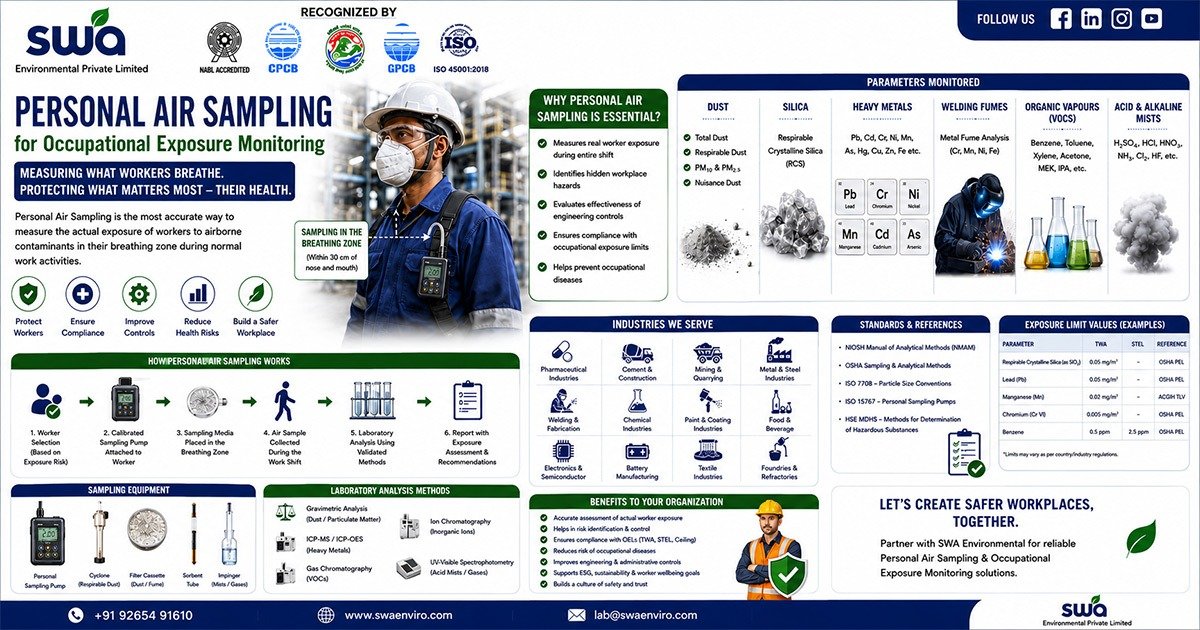
A lightweight, battery-operated sampling pump is attached to the worker’s belt or harness, while the sampling media is positioned within approximately 30 cm (12 inches) of the worker’s nose and mouth—known as the breathing zone.
As the worker performs routine tasks, the calibrated pump continuously draws a measured volume of air through a filter cassette, cyclone, impinger, or sorbent tube. The collected contaminants are then analysed in a laboratory using validated analytical techniques.
Unlike area monitoring, which measures air quality at a fixed location, personal sampling reflects the worker’s actual exposure, taking into account movement, work practices, task duration, and proximity to contaminant sources.
This makes personal air sampling the preferred approach for occupational exposure assessment under international industrial hygiene practices.
Why Ambient Air Monitoring Cannot Replace Personal Air Sampling
One of the most common misconceptions in industry is that acceptable ambient air quality automatically means workers are adequately protected.
This is not true.
Ambient air monitoring measures the overall environmental concentration of pollutants at a fixed location. It is valuable for environmental compliance but does not account for individual worker exposure.
For example:
A welder working inside a confined fabrication area may inhale high concentrations of manganese and chromium fumes, while the general workshop air remains within acceptable limits.
Similarly, a bagging operator in a cement plant may experience significantly higher respirable dust exposure than nearby employees performing administrative tasks.
Only personal air sampling captures these differences.
This distinction is critical because occupational exposure limits are based on breathing-zone concentrations, not general workplace averages.
Understanding the Breathing Zone
The breathing zone refers to the hemisphere surrounding a worker’s nose and mouth from which inhaled air is drawn.
Occupational hygienists position the sampling inlet in this zone because it represents the air entering the respiratory system.
If the sampling device is placed elsewhere, the measured concentration may not accurately reflect the worker’s true exposure.
Proper placement, calibration, and sampling duration are therefore essential to obtaining meaningful results.
Why Personal Air Sampling Matters
Occupational diseases develop gradually.
Unlike burns or fractures, inhalation hazards often produce no immediate symptoms.
Workers may continue performing their jobs for years before respiratory illnesses, neurological disorders, kidney damage, or occupational cancers become apparent.
Routine exposure monitoring allows industries to identify these risks before irreversible health effects occur.
Personal air sampling helps organizations:
- Quantify worker exposure to hazardous substances
- Identify high-risk operations
- Verify engineering control effectiveness
- Evaluate local exhaust ventilation performance
- Assess PPE adequacy
- Prioritize workplace improvements
- Demonstrate compliance with occupational exposure standards
- Protect employee health through evidence-based decisions
Airborne Hazards Commonly Monitored
Total Dust
Total dust represents all airborne particles entering the breathing zone, regardless of size.
It is commonly generated during:
- Cement manufacturing
- Powder handling
- Food processing
- Pharmaceuticals
- Minerals processing
- Agriculture
- Chemical manufacturing
Excessive dust exposure may cause chronic respiratory irritation and reduced pulmonary function.
Respirable Dust
Respirable dust consists of fine particles capable of penetrating deep into the alveolar region of the lungs.
Particles smaller than approximately 4 µm aerodynamic diameter are generally considered respirable.
These particles pose the greatest long-term health risk because they bypass the body’s natural filtration mechanisms.
Industries requiring respirable dust monitoring include:
- Mining
- Stone crushing
- Cement plants
- Construction
- Foundries
- Ceramics
Respirable Crystalline Silica (RCS)
Respirable crystalline silica is among the most significant occupational hazards worldwide.
It is generated during:
- Stone cutting
- Sand blasting
- Mining
- Concrete demolition
- Ceramic production
- Quartz processing
Long-term exposure may result in silicosis, chronic obstructive pulmonary disease (COPD), and an increased risk of lung cancer.
Because of its severe health implications, silica monitoring is increasingly emphasized in occupational health programs.
Welding Fumes
Welding fumes consist of ultrafine metal oxide particles formed during high-temperature metal joining.
Depending on the electrode and base metal, fumes may contain:
- Iron
- Manganese
- Chromium VI
- Nickel
- Copper
- Zinc
Although visually apparent, the most hazardous particles are often the smallest and remain airborne for extended periods.
Heavy Metals
Personal air sampling is widely used to assess airborne exposure to toxic metals, including:
| Metal | Typical Industry | Health Concern |
| Lead | Battery Manufacturing | Neurological damage |
| Cadmium | Electroplating | Kidney toxicity |
| Chromium VI | Stainless Steel Welding | Carcinogenic |
| Nickel | Alloy Manufacturing | Respiratory disease |
| Arsenic | Smelting | Cancer risk |
| Mercury | Chemical Industries | Nervous system damage |
| Manganese | Welding | Neurological disorders |
Collected filters are typically analysed using ICP-MS, ICP-OES, or AAS.
Organic Vapour Monitoring
Not all airborne hazards are particulate.
Many industries expose workers to volatile organic compounds (VOCs).
Examples include:
- Benzene
- Toluene
- Ethylbenzene
- Xylene
- Acetone
- IPA
- MEK
- Formaldehyde
These are sampled using activated charcoal or specialized sorbent tubes and analysed using Gas Chromatography (GC-FID or GC-MS).
Acid Mists and Inorganic Gases
Workers in electroplating, battery manufacturing, and chemical processing may require monitoring for:
- Sulphuric Acid Mist
- Hydrochloric Acid
- Nitric Acid
- Ammonia
- Chlorine
- Hydrogen Fluoride
These contaminants require dedicated sampling media and analytical methods.
International Standards and Sampling Methods
Reliable personal air sampling depends on standardized methodologies.
Commonly followed methods include:
- NIOSH Manual of Analytical Methods (NMAM)
- OSHA Sampling and Analytical Methods
- ISO 7708 (particle size conventions)
- ISO 15767 (personal sampling pumps)
- HSE Methods for the Determination of Hazardous Substances (MDHS)
Following recognized methods ensures traceable, reproducible, and technically defensible results.
Laboratory Analysis Techniques
Depending on the contaminant, laboratory analysis may include:
- Gravimetric Analysis – Total & Respirable Dust
- ICP-MS – Ultra-trace Heavy Metals
- ICP-OES – Multi-element Analysis
- Atomic Absorption Spectroscopy (AAS)
- Gas Chromatography (GC-FID / GC-MS)
- Ion Chromatography
- UV-Visible Spectrophotometry
Each method is selected based on the target analyte and required detection limits.
Interpreting Personal Air Sampling Results
Sampling results are generally expressed as mg/m³, µg/m³, or ppm, depending on the contaminant.
These concentrations are compared with occupational exposure limits such as:
- Time-Weighted Average (TWA) – Average exposure over an 8-hour work shift.
- Short-Term Exposure Limit (STEL) – Acceptable exposure over a 15-minute period.
- Ceiling Limit (C) – Concentration that should never be exceeded, even momentarily.
This comparison helps determine whether workers are adequately protected or whether additional control measures are required.
The Hierarchy of Controls
Monitoring is only the first step. When elevated exposure is identified, industries should implement the Hierarchy of Controls:
- Elimination of the hazard
- Substitution with a safer material
- Engineering controls (local exhaust ventilation, enclosure)
- Administrative controls (job rotation, work practices)
- Personal protective equipment (PPE)
Personal air sampling verifies whether these measures effectively reduce exposure.
How SWA Environmental Private Limited Supports Occupational Hygiene
At SWA Environmental Private Limited, we provide end-to-end occupational exposure assessment services using calibrated personal sampling equipment
and laboratory analysis performed with validated methods.
Our capabilities include:
- Personal Air Sampling
- Total Dust Monitoring
- Respirable Dust Analysis
- Respirable Crystalline Silica
- Heavy Metal Exposure Assessment
- Welding Fume Analysis
- VOC Monitoring
- Acid Mist Monitoring
- Industrial Hygiene Surveys
- Workplace Exposure Assessment
- Engineering Control Evaluation
- Exposure Trend Analysis
Our reports include analytical results, exposure interpretation, risk assessment, and practical recommendations to help industries strengthen workplace health programs.
Conclusion
Occupational diseases are often invisible until they become irreversible. Personal Air Sampling provides the scientific evidence needed to understand what workers are
actually breathing, identify hidden risks, and implement effective exposure controls.
For organizations committed to worker safety, regulatory compliance, and operational excellence, personal air sampling is not just a monitoring activity—it is a proactive
investment in human health and long-term business sustainability.
At SWA Environmental Private Limited, we combine advanced sampling techniques, accredited laboratory analysis, and technical expertise to deliver reliable
occupational exposure assessments that help industries create safer workplaces.
We Provide Personal Air Sampling for Occupational Exposure Monitoring across Gujarat and Rajasthan including locations Ahmedabad, Surat, Vadodara,
Rajkot, Bhavnagar, Jamnagar, Anand, Gandhinagar, Bharuch, Morbi, Vapi, Valsad, Junagadh, Nadiad, Mehsana, Porbandar, Godhra, Navsari, Surendranagar,
Patan, Amreli, Palanpur, Modasa, Dahod, Gandhidham, Bhuj, Ankleshwar, Kalol, Sanand, Halol, Kadi, Khambhat, Jetpur, Kutch, Mundra, Morbi, Rajpipla, Dwarka,
Dholka, Gandharpur, Bhachau, Chotila, Dhandhuka, Umargam, Padra, Jhagadia, Kalol, Savli, Sachin, Palghar, Godhra, Vallabh Vidyanagar, Mandvi, Halvad, Balasinor,
Nandesari, Pardi, Karamsad, Jaipur, Jodhpur, Pali, Tonk, Udaipur, Alwar, Sikar, Bikaner, Ajmer, Kota, Sri Ganganagar, Bhilwara, Banswara, Bharatpur, Baran, Beawar,
Bhiwadi, Hanumangarh, Dholpur, Pratapgarh, Dungarpur, Jaisalmer, Hindaun, Bundi, Chittorgarh, Kishangarh, Sujangarh, Sawai Madhopur, Pushkar, Churu.
- Visit: swaenviro.com
- Phone: +91 9227988980
- Email: lab@swaenviro.com