Why Nitrogen Transformation Is the Heart of Biological Treatment Systems
By SWA Environmental Private Limited
Our registered office, manufacturing facility, and advanced laboratories are located in Ahmedabad and Jaipur, India.
In wastewater treatment, one of the most critical yet misunderstood parameters is:
🌱 Nitrogen
Many industries monitor only Total Nitrogen (TN) or Ammonia, assuming it tells the complete story.
But in reality, nitrogen exists in multiple forms—and each form behaves differently inside a treatment plant.
Understanding the relationship between different nitrogen species is essential for:
✔ Stable biological treatment
✔ Effective nitrification & denitrification
✔ Low ammonia discharge
✔ Prevention of toxicity
✔ Regulatory compliance
✔ Optimized aeration cost
At SWA Environmental Private Limited, we believe successful wastewater treatment starts with understanding not just how much nitrogen is present—but which form of nitrogen exists and how it transforms.
🌡️ What Is Nitrogen in Wastewater?
Nitrogen enters wastewater from sources such as:
- Domestic sewage
- Food processing industries
- Dairy wastewater
- Fertilizer industries
- Pharmaceuticals
- Slaughterhouses
- Agricultural runoff
- Chemical manufacturing
If not treated properly, excess nitrogen can cause:
❌ Eutrophication
❌ Algal bloom formation
❌ Oxygen depletion in water bodies
❌ Fish mortality
❌ Groundwater contamination
This makes nitrogen removal one of the most important objectives in wastewater treatment.
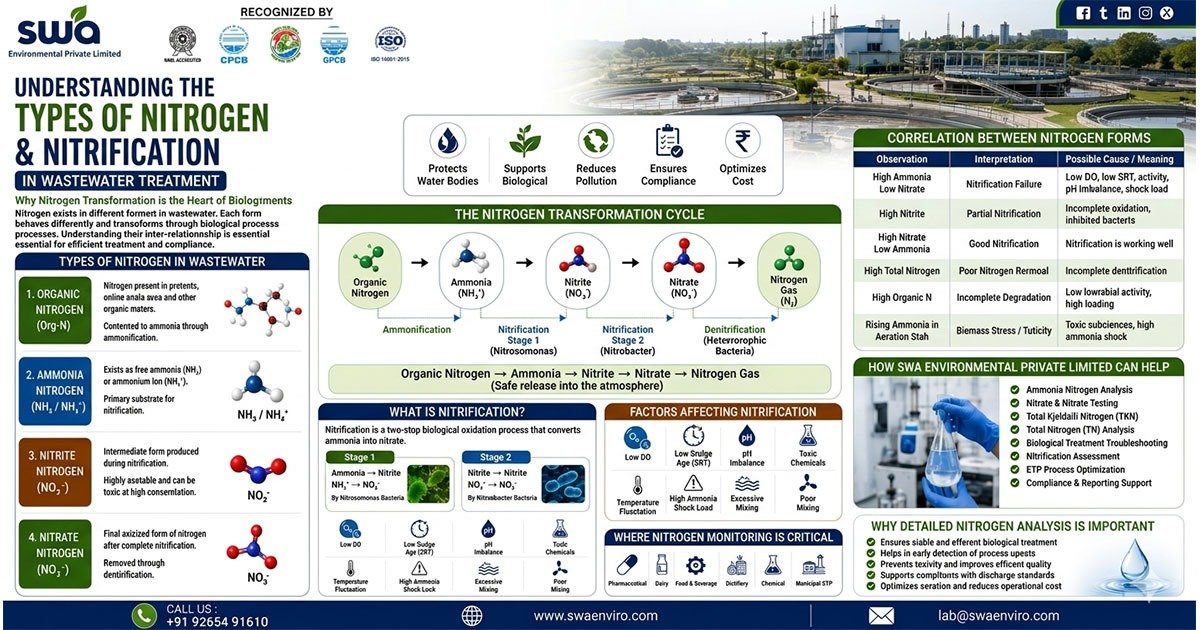
🔬 The Main Types of Nitrogen in Wastewater
-
Organic Nitrogen (Org-N)
This nitrogen is present inside:
- Proteins
- Urea
- Amino acids
- Organic waste matter
Organic nitrogen cannot be directly nitrified.
It first undergoes:
👉 Ammonification
Where microorganisms convert organic nitrogen into ammonia.
-
Ammonia Nitrogen (NH₃ / NH₄⁺)
This is the most important intermediate nitrogen form in wastewater.
Ammonia exists as:
- Free ammonia (NH₃)
- Ammonium ion (NH₄⁺)
Its balance depends on:
- pH
- Temperature
High ammonia levels can:
⚠ Be toxic to aquatic life
⚠ Inhibit biological treatment
⚠ Cause odor issues
⚠ Increase oxygen demand
Ammonia is the primary substrate for nitrification.
-
Nitrite Nitrogen (NO₂⁻)
Nitrite is an intermediate compound formed during nitrification.
It is produced when ammonia is partially oxidized by nitrifying bacteria.
⚠ Nitrite accumulation is usually a warning sign.
High nitrite may indicate:
- Low dissolved oxygen
- Toxic shock
- pH imbalance
- Incomplete nitrification
- Inhibited bacterial activity
Nitrite is highly unstable and normally converts quickly into nitrate.
-
Nitrate Nitrogen (NO₃⁻)
Nitrate is the final oxidized form of nitrogen produced after complete nitrification.
Although less toxic than ammonia or nitrite, excess nitrate in discharged water may cause:
- Eutrophication
- Groundwater contamination
- Ecological imbalance
Nitrate is removed biologically through:
👉 Denitrification
Where bacteria convert nitrate into nitrogen gas under anoxic conditions.
🔄 The Nitrogen Transformation Cycle in Wastewater
The nitrogen cycle inside a biological treatment plant follows this sequence:
Step 1: Organic Nitrogen
↓ (Ammonification)
Step 2: Ammonia (NH₄⁺)
↓ (Nitrification – Stage 1)
Step 3: Nitrite (NO₂⁻)
↓ (Nitrification – Stage 2)
Step 4: Nitrate (NO₃⁻)
↓ (Denitrification)
Step 5: Nitrogen Gas (N₂)
↑ Released safely into atmosphere
This entire process is the foundation of Biological Nutrient Removal (BNR) systems.
⚙️ What Is Nitrification?
Nitrification is a biological oxidation process where specialized bacteria convert ammonia into nitrate.
This occurs in two stages:
Stage 1: Ammonia → Nitrite
Performed by:
- Nitrosomonas bacteria
Reaction:
NH₄⁺ → NO₂⁻
Stage 2: Nitrite → Nitrate
Performed by:
- Nitrobacter bacteria
Reaction:
NO₂⁻ → NO₃⁻
⚠️ Why Nitrification Is Extremely Sensitive
Nitrification bacteria are slow-growing and highly sensitive.
Poor nitrification may occur due to:
❌ Low DO
❌ Low sludge age (SRT)
❌ Toxic chemicals
❌ pH imbalance
❌ Temperature fluctuation
❌ High ammonia shock load
❌ Excessive salinity
This is why many ETPs struggle with ammonia removal despite having aeration systems.
📊 Correlation Between Different Nitrogen Forms
Understanding nitrogen relationships helps diagnose treatment performance.
| Parameter Trend | Possible Meaning |
| High Ammonia + Low Nitrate | Nitrification failure |
| High Nitrite | Partial nitrification / stress |
| High Nitrate + Low Ammonia | Good nitrification |
| High Total Nitrogen | Poor nitrogen removal |
| High Organic N | Incomplete degradation |
| Rising Ammonia in Aeration Tank | Toxicity or biomass stress |
These correlations help operators troubleshoot process instability quickly.
🧪 Why Nitrogen Speciation Testing Is Important
Testing only Total Nitrogen is not enough.
Detailed nitrogen analysis helps determine:
✔ Whether nitrification is occurring
✔ Whether denitrification is complete
✔ Whether ammonia toxicity exists
✔ Oxygen demand requirements
✔ Process stability
✔ Nutrient loading
🏭 Industries Where Nitrogen Monitoring Is Critical
Nitrogen monitoring is especially important for:
- Pharmaceutical industries
- Fertilizer plants
- Dairy industries
- Food processing units
- Distilleries
- Slaughterhouses
- Chemical industries
- Municipal STPs
🔬 How SWA Environmental Private Limited Helps
At SWA Environmental Private Limited, we provide advanced wastewater characterization and treatment support services including:
✔ Ammonia Nitrogen Analysis
✔ Nitrate & Nitrite Testing
✔ Total Kjeldahl Nitrogen (TKN)
✔ Total Nitrogen Analysis
✔ Biological Treatment Troubleshooting
✔ Nitrification Assessment
✔ ETP Process Optimization
Our technical team helps industries understand:
👉 Not just the nitrogen value—
but the complete nitrogen behavior inside the treatment process.
🚀 Final Thoughts
Nitrogen in wastewater is not a single parameter—it is a dynamic biological transformation system.
Understanding the relationship between:
- Organic nitrogen
- Ammonia
- Nitrite
- Nitrate
…is essential for successful wastewater treatment.
Because efficient nitrogen removal is not achieved by aeration alone—
👉 It is achieved by understanding the science of nitrification and biological balance.
For professional wastewater analysis, nitrogen studies, and treatment optimization, connect with SWA Environmental Private Limited.