As cities, industries, and farmers embrace cleaner technologies and the global movement toward Zero Waste accelerates, biogas plants are emerging as powerful engines of circular economy.
While biogas production often takes the spotlight, there is another equally valuable byproduct quietly transforming agriculture: biogas slurry, also known as digestate.
At SWA Environmental Consultants & Engineers, our mission is to enable industries and communities to capture the full value of waste streams. And when it comes to digestate, the key to unlocking this value lies in scientific, periodic, and comprehensive slurry analysis.
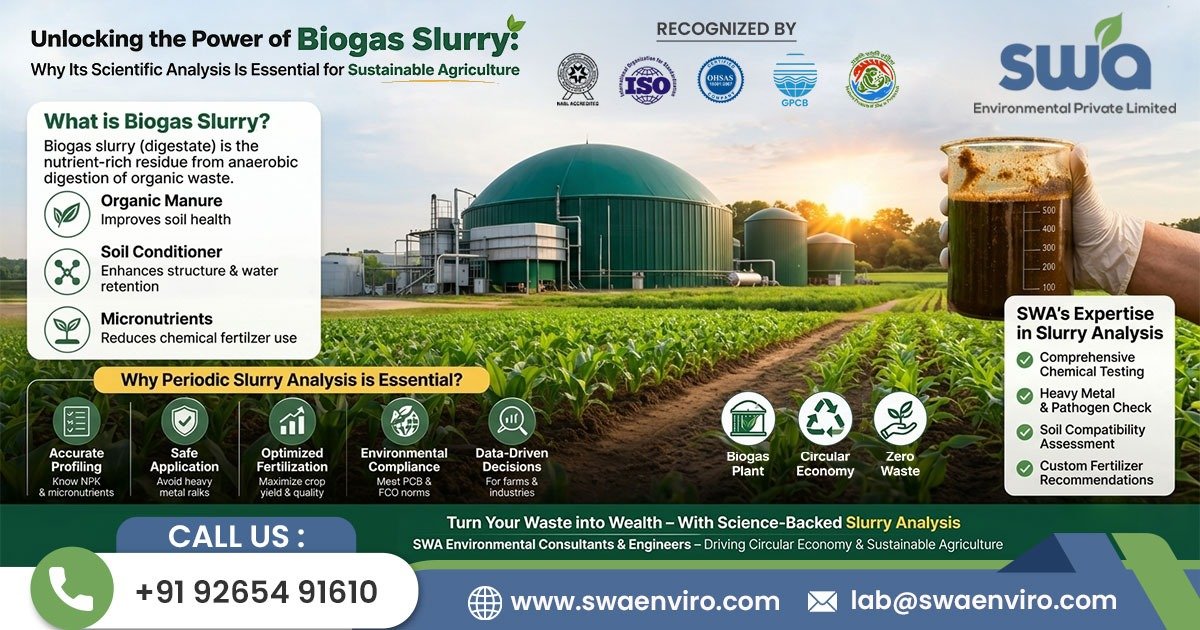
🌱 What Exactly Is Biogas Slurry—and Why Is It So Valuable?
Biogas slurry is the nutrient-rich residue produced after anaerobic digestion of organic materials like cow dung, agricultural waste, food waste, or municipal organic solids.
Calling it “waste” is a misunderstanding—because digestate is nothing short of agricultural gold.
Here’s why:
- Nutrient-Rich Organic Fertilizer
Loaded with readily available N-P-K, organic carbon, and vital micronutrients. - Superior Soil Rejuvenator
Improves soil aeration, structure, water-holding capacity, and microbial health. - Naturally Sanitized
Anaerobic digestion significantly reduces pathogens, parasites, and weed seeds found in raw manure. - Eco-Friendly
Supports sustainable, chemical-free farming and reduces dependence on synthetic fertilizers.
But the catch?
✦ Its quality is never constant.
✦ Its safety cannot be assumed.
This is exactly why regular analysis is critical.
🔍 Why Biogas Slurry Analysis Is Absolutely Necessary
Biogas slurry varies based on the feedstock, digestion efficiency, microbial performance, and plant operation conditions. Without detailed testing, using slurry becomes guesswork—and guesswork in agriculture is expensive.
1. Accurate Nutrient Profiling for Precision Agriculture
Different feedstocks = different nutrient outputs.
A lab analysis provides:
- Exact N, P, K levels
- Available micronutrients
- Organic carbon percentage
- C:N ratio
- pH and electrical conductivity
This empowers farmers to:
- Apply the right amount of slurry
- Avoid nutrient overload
- Boost yield with precision fertilization
- Reduce chemical fertilizer costs
Outcome: Better soil. Better crops. Lower input costs.
2. Insight into Biogas Plant Efficiency & Troubleshooting
Digestate composition acts as a health indicator for your biogas plant.
High levels of:
- Volatile Fatty Acids (VFAs)
- Volatile Solids (VS)
- Undigested material
…often signal:
- Digester imbalance
- Overloading
- Microbial inhibition
- Reduced gas production
Routine analysis helps operators optimize:
- Feedstock blending
- Loading rates
- Digestion retention time
- Microbial performance
Result: Higher biogas yield and stable plant operations.
3. Detecting Heavy Metals & Contaminants for Safe Use
Plants handling municipal waste, food industry residues, or mixed organics may contain:
- Lead (Pb)
- Cadmium (Cd)
- Arsenic (As)
- Chromium (Cr)
- Other toxic metals
Without tested assurance, applying contaminated slurry can:
- Harm soil health
- Enter the food chain
- Reduce crop safety
- Breach environmental norms
Testing ensures digestate is safe, compliant, and suitable for agriculture.
4. Meeting Environmental, Agricultural & Regulatory Compliance
Regulatory bodies like:
- GPCB (Gujarat Pollution Control Board)
- CPCB (Central Pollution Control Board)
- MoEFCC
require strict monitoring of waste outputs such as compost, sludge, and digestate.
Regular testing supports:
- Zero Waste compliance
- Safe handling & land application
- Environmental audits
- Project approvals
- Certification & traceability
💡 How SWA Environmental Consultants & Engineers Supports You
Headquartered in Ahmedabad, SWA Environmental Consultants & Engineers is a leading environmental engineering and consultancy firm working towards the vision of:
- ✔ Zero Liquid Discharge Industries
- ✔ Zero Waste Cities
- ✔ Sustainable Resource Recovery
Our NABL-accredited laboratory offers high-precision testing for:
- Biogas slurry & digestate
- Hazardous waste
- Soil, sludge & compost
- Groundwater & wastewater
- Industrial effluents
- Solid waste characterization
Our services help you:
- Maximize biogas plant performance
- Ensure agricultural-grade slurry quality
- Maintain regulatory compliance
- Optimize microbial efficiency
- Reduce environmental risk
Whether you need nutrient profiling, digestate certification, or biogas plant troubleshooting, our expert team of technocrats provides end-to-end, practical, and economical solutions.
🌿 Turn Waste Into Wealth—With Science Backing Every Step
Biogas slurry is one of the most powerful yet underutilized tools for sustainable agriculture and circular economy. But unlocking its full potential requires one essential step:
✔ Scientific and regular analysis by accredited professionals.
To learn more about digestate testing, biogas plant optimization, and environmental engineering solutions, visit:
Let’s build cleaner cities, greener farms, and a sustainable future—together.
We Provide Biogas Slurry Analysis Across Gujarat
We provide Biogas Slurry Analysis across Gujarat, including Ahmedabad, Surat, Vadodara, Rajkot, Bhavnagar, Jamnagar, Anand, Gandhinagar, Bharuch, Morbi, Vapi, Valsad, Junagadh, Nadiad, Mehsana, Porbandar, Godhra, Navsari, Surendranagar, Patan, Amreli, Palanpur, Modasa, Dahod, Gandhidham, Bhuj, Ankleshwar, Kalol, Sanand, Halol, Kadi, Khambhat, Jetpur, Kutch, Mundra, Morbi, Rajpipla, Dwarka, Dholka, Gandharpur, Bhachau, Chotila, Dhandhuka, Umargam, Padra, Jhagadia, Kalol, Savli, Sachin, Palghar, Godhra, Vallabh Vidyanagar, Mandvi, Halvad, Balasinor, Nandesari, Pardi, Karamsad, and many more.
Contact Information
- Phone: +91 9227988980
- Email: lab@swaenviro.com
- Website: www.swaenviro.com