
Diesel generators are essential for reliable backup power, but excessive noise can affect employees, nearby communities and regulatory compliance.
An acoustic enclosure may appear robust, yet its actual performance can only be confirmed through systematic diesel generator insertion loss testing.
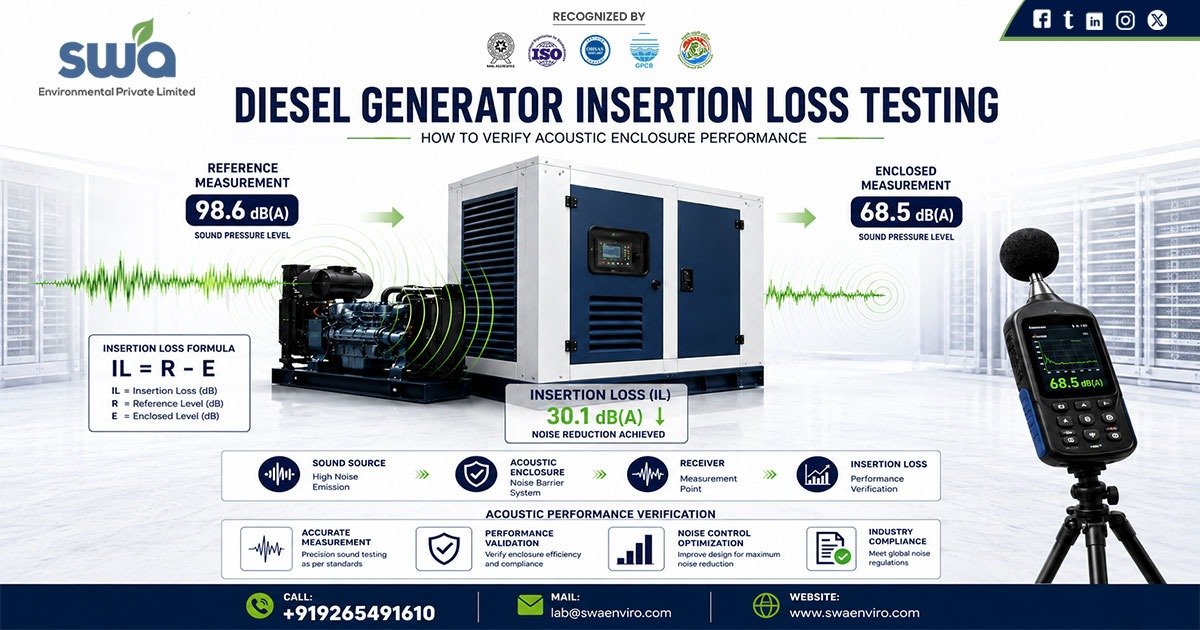
Insertion loss testing compares noise levels generated by a diesel generator before and after installing or closing its acoustic enclosure.
The results help determine whether the enclosure provides the required noise reduction under real operating conditions.
SWA Environmental Private Limited – Consultants & Engineers helps industries evaluate diesel generator noise, identify acoustic weaknesses and plan
practical noise-control improvements.
What Is Diesel Generator Insertion Loss?
Diesel generator insertion loss is the reduction in sound level achieved by placing an acoustic enclosure or barrier around the generator.
It is generally expressed in decibels:
Insertion Loss (dB) = Noise level without enclosure − Noise level with enclosure
For example:
- Noise without the enclosure: 102 dB(A)
- Noise with the enclosure: 77 dB(A)
- Overall insertion loss: 25 dB(A)
A higher insertion-loss value usually indicates better enclosure performance. However, results must be evaluated by frequency because low-frequency engine and exhaust noise can remain significant even when the overall dB(A) value appears acceptable.
Why Is Acoustic Enclosure Performance Testing Important?
Diesel generator enclosure testing helps facility owners and project teams:
- Verify the acoustic enclosure manufacturer’s performance claims.
- Check compliance with applicable environmental noise requirements.
- Identify noise leakage through doors, joints and ventilation openings.
- Evaluate performance under actual generator operating conditions.
- Protect workers from excessive occupational noise exposure.
- Reduce noise disturbance at nearby residential or sensitive locations.
- Establish baseline data for maintenance and future comparison.
- Prevent costly complaints, retrofits and operational restrictions.
Visual inspection alone cannot confirm acoustic performance. An enclosure may contain acoustic insulation but still allow noise to escape through poorly sealed openings or inadequately designed ventilation paths.
Common Sources of Diesel Generator Noise
A diesel generator produces noise through several components and transmission paths:
- Engine Noise
2. Exhaust Noise
3. Cooling-Fan Noise
4. Structural Vibration
5. Air Inlet and Outlet Openings
6. Enclosure Leakage
How Is Diesel Generator Insertion Loss Testing Conducted?
A reliable testing programme should follow a controlled and repeatable process.
Step 1: Review the Performance Requirement
Before testing, the acoustic consultant reviews:
- Required insertion-loss value
- Applicable project specifications
- Generator capacity and operating load
- Enclosure design and construction
- Noise limits at the site boundary or receptor
- Relevant environmental and occupational requirements
- Previous noise reports, if available
Step 2: Inspect the Generator and Enclosure
A physical inspection is conducted to identify potential acoustic weaknesses, including:
- Unsealed doors and access panels
- Damaged acoustic insulation
- Open cable or pipe penetrations
- Improper exhaust connections
- Inadequate anti-vibration mounts
- Poorly fitted acoustic louvers
- Direct airflow noise paths
- Loose or vibrating enclosure panels
Step 3: Establish Measurement Positions
Microphone locations should represent the major sides and noise paths of the generator. Positions may include:
- Radiator or air-discharge side
- Air-inlet side
- Generator-control side
- Engine side
- Exhaust outlet area
- Operator position
- Property boundary
- Nearby sensitive receptor
The same microphone height, distance and orientation should be maintained during comparative measurements.
Step 4: Measure Background Noise
Background noise is measured when the generator is not operating. This helps determine whether unrelated sources—such as traffic, machinery,
construction or nearby equipment—could influence the test results.
Step 5: Measure Noise Without Enclosure Attenuation
Where technically feasible and safe, baseline measurements are taken without the enclosure’s acoustic effect. This may involve testing with enclosure doors or
removable panels open, or using documented pre-installation data.
The selected method must not compromise safety, airflow, cooling or generator operation.
Step 6: Measure Noise With the Enclosure Operational
The generator is tested with:
- All enclosure doors properly closed
- Access panels secured
- Ventilation system operating normally
- Exhaust system fully connected
- Generator operating at a defined and stable load
Operating conditions should remain comparable throughout the test.
Step 7: Calculate Insertion Loss
Insertion loss is calculated at each measurement location and, preferably, across octave or one-third-octave frequency bands.
Frequency-based analysis can reveal whether the enclosure performs poorly against:
- Low-frequency engine pulsation
- Mid-frequency mechanical noise
- High-frequency fan or airflow noise
- Tonal noise from rotating components
Step 8: Assess Compliance and Recommend Improvements
The measured results are compared with project requirements and applicable noise criteria. If performance is inadequate, corrective measures are recommended.
Key Conditions for Reliable Test Results
Insertion loss testing should control the following factors:
- Generator load should remain stable and documented.
- Engine speed must be consistent during both measurements.
- Microphone locations and distances must remain unchanged.
- Enclosure doors and panels must be in their normal operating position.
- Wind, rain and extreme weather conditions should be avoided.
- The sound-level meter should be appropriately calibrated.
- Background noise must be sufficiently below generator noise.
- Nearby reflective surfaces should be considered.
- Other equipment should not interfere with measurements.
- Test procedures and operating conditions must be clearly recorded.
Without comparable conditions, the calculated difference may not represent the enclosure’s true acoustic performance.
Overall dB(A) Versus Frequency-Based Insertion Loss
An overall A-weighted noise level provides a convenient summary, but it does not tell the complete story.
A generator enclosure may achieve good high-frequency attenuation while performing poorly at low frequencies. Low-frequency sound travels farther, passes more easily through lightweight panels and can create vibration or nuisance at distant receptors.
A professional assessment should therefore consider:
- Overall sound pressure level in dB(A)
- Octave or one-third-octave band levels
- Tonal characteristics
- Low-frequency noise
- Measurement uncertainty
- Generator load and operating condition
- Noise levels at sensitive receptors
Why Acoustic Enclosures Sometimes Fail
Common causes of inadequate insertion loss include:
- Insufficient panel mass or acoustic insulation
- Poor door seals
- Gaps between enclosure panels
- Untreated ventilation openings
- Short or incorrectly designed acoustic splitters
- Inadequate exhaust silencer performance
- Rigid connections that transmit vibration
- Poor foundation isolation
- Untreated cable and pipe penetrations
- Deteriorated insulation or seals
- Panel resonance
- Changes made after the original enclosure installation
Even a small opening can weaken the performance of an otherwise well-designed acoustic enclosure.
Corrective Measures for Poor Enclosure Performance
Depending on the test findings, noise-control improvements may include:
- Sealing gaps and service penetrations
- Replacing damaged door gaskets
- Upgrading acoustic insulation
- Increasing enclosure panel mass
- Installing suitable acoustic louvers
- Extending ventilation splitters
- Adding reactive or absorptive silencers
- Improving exhaust silencer selection
- Installing flexible pipe connections
- Upgrading anti-vibration mounts
- Isolating the generator foundation
- Stiffening resonant enclosure panels
- Constructing external acoustic barriers
- Reconfiguring air-inlet and discharge paths
Recommendations should consider noise reduction, generator cooling, airflow, fire safety, access and maintenance requirements together.
When Should Insertion Loss Testing Be Performed?
Testing is valuable:
- During generator commissioning
- Before accepting a new acoustic enclosure
- After relocating a diesel generator
- Following enclosure modification
- After receiving a community noise complaint
- When site conditions or nearby land use change
- After replacing silencers, fans or ventilation components
- During periodic environmental noise audits
- When deterioration or physical damage is observed
Information Included in an Insertion Loss Test Report
A professional report may document:
- Generator make, model and rated capacity
- Test date, time and location
- Generator load and operating conditions
- Measurement equipment and calibration details
- Weather and background-noise conditions
- Microphone locations and distances
- Overall and frequency-band noise results
- Calculated insertion loss
- Observed noise leakage paths
- Relevant compliance assessment
- Photographs and measurement layout
- Recommended noise-control measures
Clear reporting allows results to be reviewed by project managers, environmental teams, contractors, enclosure manufacturers and regulatory stakeholders.
Benefits of Working With SWA Environmental Private Limited
SWA Environmental Private Limited – Consultants & Engineers can support diesel generator acoustic assessments through:
- Planned and systematic noise measurements
- Evaluation of enclosure performance
- Frequency-based noise analysis
- Identification of dominant noise sources
- Assessment of leakage and vibration paths
- Practical engineering recommendations
- Support for commissioning and troubleshooting
- Clear technical reporting for project decisions
The objective is not simply to record a noise level. It is to determine whether the complete generator-and-enclosure system performs effectively in its actual operating environment.
Frequently Asked Questions
Q1: What is an acceptable insertion loss for a generator enclosure?
A1: The required value depends on generator noise, project specifications, site conditions and applicable limits.
Q2: Can insertion loss be measured using only dB(A)?
A2: Yes, but frequency-band measurements provide a more reliable diagnosis of low-frequency and tonal noise.
Q3: Must the generator operate at full load during testing?
A3: Testing should use a defined, stable and representative load, preferably matching the specified assessment condition.
Q4: Why is noise high despite acoustic insulation?
A4: Noise may escape through ventilation openings, door gaps, exhaust systems, penetrations or vibration-transmission paths.
Q5: How often should an enclosure be retested?
A5: Retesting is advisable after modifications, relocation, deterioration, complaints or significant changes in operating conditions.
We provide Diesel Generator Insertion Loss Testing in Gujarat and Rajasthan including locations
Ahmedabad, Surat, Vadodara, Rajkot, Bhavnagar, Jamnagar, Anand, Gandhinagar, Bharuch, Morbi, Vapi, Valsad, Junagadh, Nadiad, Mehsana, Porbandar, Godhra, Navsari, Surendranagar, Patan, Amreli, Palanpur, Modasa, Dahod, Gandhidham, Bhuj, Ankleshwar, Kalol, Sanand, Halol, Kadi, Khambhat, Jetpur, Kutch, Mundra, Morbi, Rajpipla, Dwarka, Dholka, Gandharpur, Bhachau, Chotila, Dhandhuka, Umargam, Padra, Jhagadia, Kalol, Savli, Sachin, Palghar, Godhra, Vallabh Vidyanagar, Mandvi, Halvad, Balasinor, Nandesari, Pardi, Karamsad, Jaipur, Jodhpur, Pali, Tonk, Udaipur, Alwar, Sikar, Balotra, Bikaner, Ajmer, Kota, Sri Ganganagar, Bhilwara, Banswara, Bharatpur, Baran, Beawar, Bhiwadi, Hanumangarh, Dholpur, Pratapgarh, Dungarpur, Jaisalmer, Hindaun, Bundi, Chittorgarh, Kishangarh, Sujangarh, Sawai Madhopur, Pushkar, Churu.
Contact SWA Environmental Private Limited today to verify generator enclosure performance and achieve dependable noise compliance confidently.
Website: www.swaenviro.com
Phone: +919265491610
Email: lab@swaenviro.com
View Product: Click here