
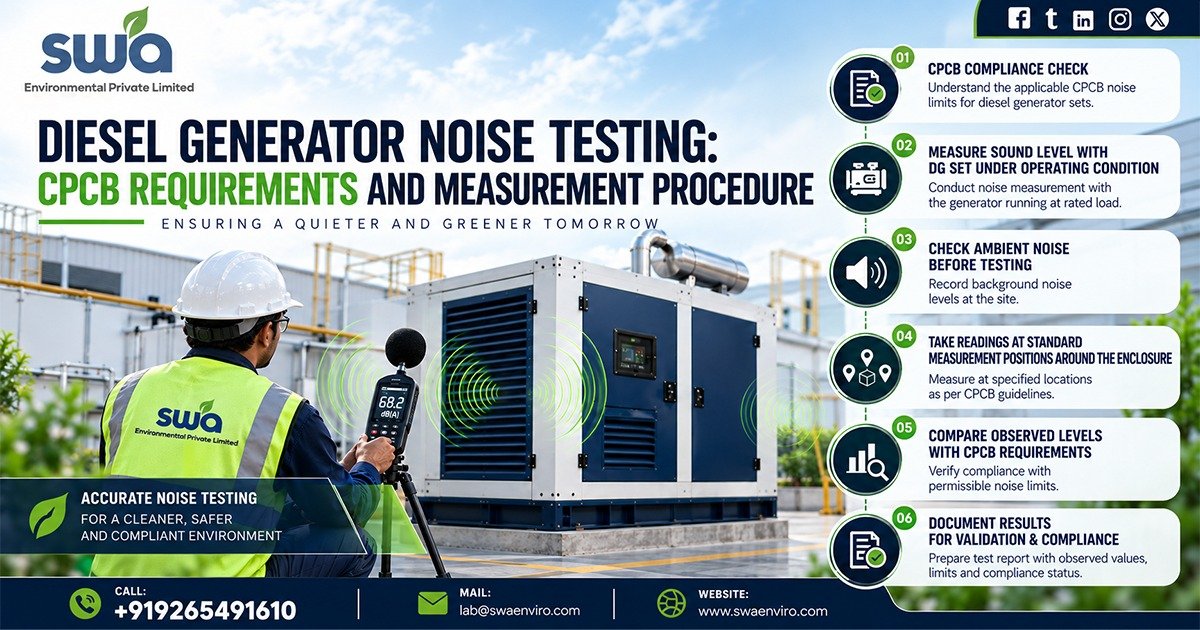
What Is the CPCB Noise Limit for Diesel Generators?
For new diesel generator sets rated up to 1,000 kVA, manufactured on or after 1 January 2005, the prescribed maximum sound pressure level is 75 dB(A),
measured at one metre from the enclosure surface. These sets must have an integral acoustic enclosure installed during manufacture.
- dB(A) expresses sound level using frequency weighting related to human hearing.
- The one-metre limit applies to the specified DG category.
- Ambient noise around a facility requires a separate assessment.
- Identify the applicable requirements using the generator’s capacity, manufacturing date and regulatory category.
CPCB Requirements for DG Set Noise Control
Acoustic Enclosures and Exhaust Mufflers
For DG sets outside the category described above:
- Provide an acoustic enclosure or acoustically treat the generator room.
- Design for at least 25 dB(A) insertion loss, or the attenuation needed to meet ambient standards, whichever is more stringent.
- Provide an exhaust muffler with at least 25 dB(A) insertion loss.
- Assess enclosure or room insertion loss using readings at multiple points 0.5 metres away, followed by the prescribed averaging.
Product Certification
Applicable manufacturers and importers require Type Approval and Conformity of Production certification. An on-site noise survey does not replace these product certification requirements.
Ambient Noise Standards
Assess surrounding noise against the applicable area classification under India’s Noise Pollution Rules.
| Area Category | Day Limit, dB(A) Leq | Night Limit, dB(A) Leq |
|---|---|---|
| Industrial | 75 | 70 |
| Commercial | 65 | 55 |
| Residential | 55 | 45 |
| Silence Zone | 50 | 40 |
Day: 6:00 a.m.–10:00 p.m.
Night: 10:00 p.m.–6:00 a.m.
Leq represents the equivalent continuous sound level over the measurement period. Meeting the DG enclosure limit alone does not establish compliance with surrounding ambient noise limits.
Diesel Generator Noise Measurement Procedure
Step 1: Define the Testing Objective
Before testing, establish whether the assessment concerns:
- Noise near the DG enclosure.
- Ambient noise at the premises boundary or affected location.
- Acoustic enclosure insertion loss.
- Formal product certification.
Record the generator’s make, model, capacity, installation details and operating load.
Step 2: Prepare the Monitoring Equipment
For environmental noise monitoring:
- Use a suitable integrating sound level meter with valid calibration.
- Perform field calibration checks before and after monitoring.
- Use a tripod and appropriate microphone windscreen.
- Record weather conditions and nearby sound sources.
CPCB’s ambient monitoring protocol specifies tripod-mounted measurements, generally 1–1.5 metres above ground, and advises avoiding handheld monitoring.
Step 3: Select and Document Measurement Locations
- Identify positions around the DG enclosure for source assessment.
- Select separate boundary or receptor locations for ambient monitoring.
- Record microphone height, distance and nearby reflecting surfaces.
- Document background noise with the generator switched off where practicable.
Use the measurement geometry required by the selected method; enclosure readings and ambient readings serve different purposes.
Step 4: Operate the Generator Under Defined Conditions
- Allow the generator to stabilise.
- Record load, speed and enclosure condition.
- Keep operating conditions consistent across comparable measurements.
For formal CPCB certification testing, the published procedure specifies 30 minutes at rated load, enclosure temperature checks and exhaust back-pressure verification before noise measurements.
Step 5: Measure and Evaluate Noise
- Record A-weighted results at each planned location.
- Use an appropriate monitoring duration for the assessment objective.
- Document unrelated noise events and apply method-specific corrections where required.
- Compare results with the relevant source or ambient criterion.
Formal certification follows ISO 8528 Part 10, with grade 2 accuracy, and derives the one-metre A-weighted sound pressure level from sound power under the specified assumptions. A few handheld readings cannot substitute for that procedure.
Step 6: Prepare the Noise Testing Report
A useful report should include:
- Generator identification and operating conditions.
- Test method, instruments and calibration records.
- Measurement locations and monitoring duration.
- Background noise and weather observations.
- Results, applicable limits and assessment limitations.
- Recommended corrective measures and retesting needs.
How to Reduce Excessive Diesel Generator Noise
Where testing identifies elevated noise, investigate:
- Damaged enclosure seals or loose panels.
- Deteriorated acoustic lining.
- Exhaust leaks or ineffective silencers.
- Vibration transmission through mounts and foundations.
- Generator placement near sensitive neighbouring spaces.
Coordinate modifications with the equipment manufacturer so noise controls preserve ventilation, cooling and safe operation.
Planning Your Assessment with SWA Environmental Private Limited
To discuss diesel generator noise testing, share:
- Your facility location and surrounding land use.
- DG capacity, quantity and manufacturing details.
- Normal operating load and usage schedule.
- Available test reports and consent conditions.
- Any noise complaints or recent equipment changes.
These details help define the assessment scope and the measurements needed.
Frequently Asked Questions
1. What is the CPCB noise limit for DG sets?
For the specified post-1 January 2005 DG category up to 1,000 kVA, it is 75 dB(A) at one metre.
2. Is one metre measured from the engine?
No. For the stated limit, the reference is the acoustic enclosure surface.
3. Are enclosure and ambient noise limits identical?
No. Ambient limits depend on the area classification and whether monitoring occurs during daytime or nighttime.
4. Can a mobile app replace professional noise testing?
Use instruments meeting the applicable test method and calibration requirements; an ordinary mobile app is insufficient.
5. Does an on-site report replace Type Approval?
No. Product certification and site noise assessment serve separate purposes.
6. What should follow an excessive noise result?
Investigate the source, implement suitable controls and repeat measurements under comparable operating conditions.
Diesel Generator Noise Testing Service in Gujarat and Rajasthan
We provide Diesel Generator Noise Testing Service in Gujarat and Rajasthan, including:
Gujarat: Ahmedabad, Surat, Vadodara, Rajkot, Bhavnagar, Jamnagar, Anand, Gandhinagar, Bharuch, Morbi, Vapi, Valsad, Junagadh, Nadiad, Mehsana, Porbandar, Godhra,
Navsari, Surendranagar, Patan, Amreli, Palanpur, Modasa, Dahod, Gandhidham, Bhuj, Ankleshwar, Kalol, Sanand, Halol, Kadi, Khambhat, Jetpur, Kutch, Mundra, Rajpipla,
Dwarka, Dholka, Gandharpur, Bhachau, Chotila, Dhandhuka, Umargam, Padra, Jhagadia, Savli, Sachin, Palghar, Vallabh Vidyanagar, Mandvi, Halvad, Balasinor, Nandesari,
Pardi, Karamsad.
Rajasthan: Jaipur, Jodhpur, Pali, Tonk, Udaipur, Alwar, Sikar, Balotra, Bikaner, Ajmer, Kota, Sri Ganganagar, Bhilwara, Banswara, Bharatpur, Baran, Beawar, Bhiwadi,
Hanumangarh, Dholpur, Pratapgarh, Dungarpur, Jaisalmer, Hindaun, Bundi, Chittorgarh, Kishangarh, Sujangarh, Sawai Madhopur, Pushkar, Churu.
Turn generator noise into actionable insights; contact SWA Environmental Private Limited to discuss your testing requirements.
Website: www.swaenviro.com
Phone: +91 92654 91610
Email: lab@swaenviro.com