
Understanding the Hidden Science Behind Efficient Water & Wastewater Treatment
By SWA Environmental Private Limited
Our registered office, manufacturing facility, and advanced laboratories are located in Ahmedabad and Jaipur, India.
In water and wastewater treatment, most industries focus on parameters like pH, COD, BOD, TSS, or turbidity
While these are important, one critical factor often remains overlooked:
👉 Particle Size Distribution (PSD)
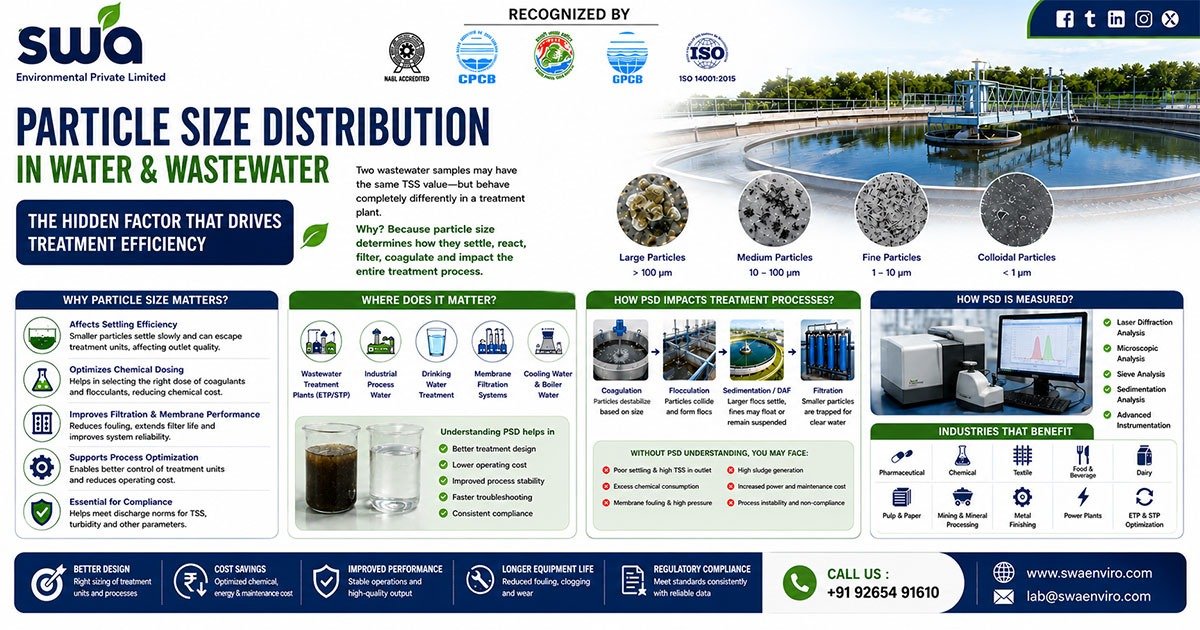
Two wastewater samples may show the same TSS value—but behave completely differently inside a treatment plant.
Why?
Because the size of particles determines how they settle, react, float, filter, coagulate, and impact the entire treatment process.
At SWA Environmental Private Limited, we believe understanding Particle Size Distribution is essential for designing efficient, economical, and stable treatment systems.
What Is Particle Size Distribution (PSD)?
Particle Size Distribution refers to the measurement and classification of particles present in water or wastewater based on their size.
These particles may include:
- Suspended solids
- Colloidal particles
- Organic matter
- Silt & clay
- Biomass flocs
- Metal precipitates
- Oil droplets
- Industrial residues
PSD tells us:
- ✔️ How many particles are present
- ✔️ How large or small they are
- ✔️ How they behave during treatment
This information is extremely valuable because particle behavior directly affects treatment efficiency.
Why Particle Size Matters in Water & Wastewater Treatment
Settling Efficiency Depends on Particle Size
Larger particles settle quickly.
Smaller particles remain suspended for longer periods and may escape treatment systems.
This directly affects:
- Clarifier performance
- Sedimentation efficiency
- Sludge generation
- Outlet TSS quality
Very fine particles may require:
- Coagulation
- Flocculation
- Dissolved Air Flotation (DAF)
- Advanced filtration
Without understanding PSD, treatment systems may fail to remove solids effectively.
Helps Select the Right Treatment Technology
Different particle sizes require different treatment approaches.
| Particle Type | Typical Treatment |
|---|---|
| Large suspended solids | Sedimentation |
| Fine colloidal particles | Coagulation & Flocculation |
| Ultra-fine particles | Membrane filtration |
| Oil droplets | DAF / Oil separation |
Knowing PSD helps engineers avoid:
- ❌ Overdesign
- ❌ Undersized systems
- ❌ Unnecessary chemical usage
- ❌ Poor treatment performance
Improves Chemical Dosing Optimization
Chemical consumption in treatment plants is heavily influenced by particle characteristics.
Fine colloidal particles usually require:
- Higher coagulant dosage
- Better flocculation control
- Longer retention time
Incorrect PSD understanding often leads to:
- Excess chemical consumption
- Poor floc formation
- High sludge generation
- Increased operating costs
Accurate PSD analysis enables precise dosing and process optimization.
Critical for Membrane & Filtration Systems
In systems like:
- UF (Ultrafiltration)
- RO (Reverse Osmosis)
- Sand filtration
- Cartridge filtration
Particle size directly affects:
- Fouling tendency
- Pressure drop
- Filter life
- Cleaning frequency
- Membrane performance
Fine particles and colloids are one of the major reasons for membrane fouling and operational instability.
PSD analysis helps industries protect expensive filtration systems.
Particle Size Distribution in Biological Treatment Systems
In biological treatment plants, PSD influences:
- Biomass floc formation
- Oxygen transfer efficiency
- Sludge settling characteristics
- SVI (Sludge Volume Index)
- Clarifier performance
Poor particle characteristics may cause:
- Bulking sludge
- Pin floc issues
- Turbid outlet water
- Biomass washout
Understanding PSD helps optimize biological system stability and sludge management.
Why TSS Alone Is Not Enough
Two wastewater streams may have:
- ✔️ Same TSS
- ✔️ Same turbidity
…but completely different treatment behavior.
Example:
- Wastewater with large particles settles easily
- Wastewater with ultra-fine colloids may remain suspended for days
This is why relying only on TSS values can be misleading.
PSD provides the missing engineering insight.
Industries Where PSD Is Extremely Important
Particle Size Distribution analysis is especially valuable for:
- Pharmaceutical industries
- Chemical manufacturing
- Textile industries
- Food & beverage plants
- Dairy industries
- Pulp & paper mills
- Mining & mineral processing
- Metal finishing industries
- ETP & STP optimization projects
How Particle Size Distribution Is Measured
Advanced laboratories use techniques such as:
- Laser diffraction analysis
- Sieve analysis
- Microscopic imaging
- Dynamic light scattering (DLS)
- Sedimentation analysis
These methods help determine:
- ✔️ Mean particle size
- ✔️ Distribution range
- ✔️ Particle uniformity
- ✔️ Fine colloidal fractions
Why Understanding PSD Changes Everything
Better Treatment Design
Correct sizing of:
- Clarifiers
- DAF systems
- Filters
- Membranes
- Chemical dosing systems
Lower Operating Cost
Reduced:
- Chemical consumption
- Sludge generation
- Energy usage
- Maintenance frequency
Improved Compliance
Better control of:
- TSS
- Turbidity
- COD carryover
- Membrane fouling
Faster Troubleshooting
PSD helps identify:
- Why solids are not settling
- Why filters are clogging
- Why clarifiers fail
- Why outlet quality fluctuates
How SWA Environmental Private Limited Helps
At SWA Environmental Private Limited, we provide scientific analysis and engineering support for water and wastewater characterization.
Our services help industries understand:
- ✔️ Particle behavior
- ✔️ Treatment limitations
- ✔️ Process optimization opportunities
- ✔️ Technology selection requirements
We support industries with:
- Wastewater characterization
- ETP troubleshooting
- Treatability assessment
- Advanced analytical testing
- Process optimization studies
Our goal is simple:
👉 Transform data into engineering solutions.
Final Thoughts
In water and wastewater treatment, particle size is not just a laboratory parameter—it is a process-defining factor.
Understanding Particle Size Distribution helps industries:
- ✔️ Improve treatment efficiency
- ✔️ Reduce operational cost
- ✔️ Prevent process failures
- ✔️ Protect filtration systems
- ✔️ Achieve stable compliance
Because successful treatment is not just about “how much” pollution exists—
It is about understanding the nature of the particles themselves.
Contact
We are a trusted service provider of Particle Size Distribution in Water and Wastewater in Gujarat, including Ahmedabad, Surat, Vadodara, Rajkot, Bhavnagar, Jamnagar,
and many other cities.
For professional water and wastewater analysis solutions, connect with SWA Environmental Private Limited:
- Visit: www.swaenviro.com
- Phone: +91 9227988980
- Email: lab@swaenviro.com