
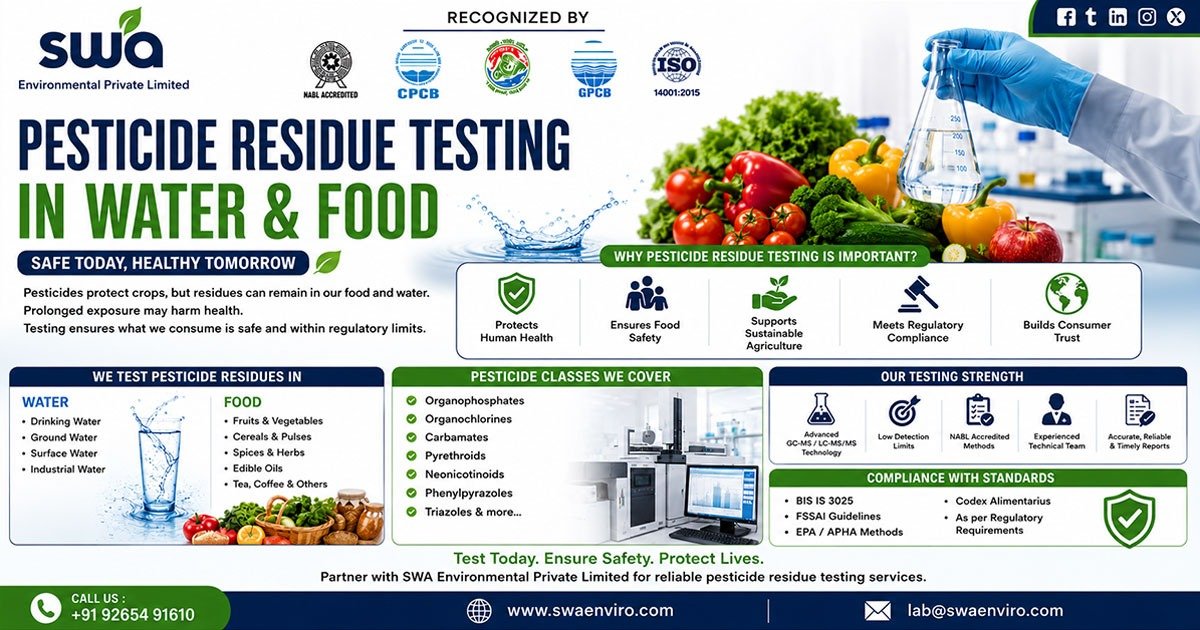
Protecting Human Health, Food Safety & Environmental Sustainability By SWA Environmental Private Limited
Our registered office, manufacturing facility, and advanced laboratories are located in Ahmedabad and Jaipur, India.
Modern agriculture has significantly improved food production, but the excessive and unregulated use of pesticides has created a serious concern for both human health and the environment. Today, pesticide residues are being detected not only in fruits and vegetables, but also in groundwater, drinking water, milk, grains, packaged food, and even processed food products.
This is why Pesticide Residue Testing has become one of the most critical analytical services for industries, food processors, exporters, farmers, regulatory authorities, and consumers.
We believe food and water safety begin with accurate scientific testing and reliable analytical data.
🌍 What Are Pesticide Residues?
Pesticide residues are the traces of chemicals that remain in food, soil, or water after pesticides are applied to crops.
These include:
- Insecticides
- Herbicides
- Fungicides
- Rodenticides
- Plant growth regulators
While pesticides help protect crops from pests and diseases, improper usage, excessive dosage, or poor degradation can leave harmful residues behind.
⚠️ Why Pesticide Residue Testing Is Important
1. Protecting Human Health
Long-term exposure to pesticide residues may cause:
- Hormonal imbalance
- Neurological disorders
- Liver & kidney damage
- Reproductive issues
- Developmental problems in children
- Increased cancer risk
Even low concentrations can accumulate in the body over time.
This makes regular testing essential for ensuring safe food and water consumption.
2. Ensuring Food Safety & Regulatory Compliance
National and international agencies have established strict Maximum Residue Limits (MRLs) for pesticides in food products.
Testing is essential for compliance with:
- FSSAI
- APEDA
- EU Regulations
- USFDA Standards
- Codex Alimentarius
- Export quality requirements
Failure to comply can result in:
- Export rejection
- Legal penalties
- Brand reputation damage
- Market losses
3. Monitoring Drinking Water & Groundwater Safety
Pesticides sprayed on agricultural fields often seep into:
- Groundwater
- Surface water
- Rivers & lakes
- Drinking water sources
Contaminated water may contain toxic compounds that are invisible, odorless, and harmful even at trace levels.
Testing helps identify contamination before it becomes a public health issue.
4. Supporting Sustainable Agriculture
Scientific residue monitoring encourages:
- Controlled pesticide application
- Safe harvesting intervals
- Better agricultural practices
- Reduced environmental contamination
- Sustainable farming systems
Testing helps farmers and industries move toward safer and more responsible agriculture.
🔬 How Pesticide Residue Testing Is Performed
Advanced laboratories use sophisticated analytical instruments such as:
- GC-MS/MS (Gas Chromatography Mass Spectrometry)
- LC-MS/MS (Liquid Chromatography Mass Spectrometry)
- HPLC
- GC-ECD / FID
These instruments can detect pesticide residues at extremely low concentrations—even in parts per billion (ppb).
Testing can be performed for:
🍎 Food Samples
- Fruits & vegetables
- Cereals & grains
- Spices
- Milk & dairy products
- Tea & beverages
- Processed foods
💧 Water Samples
- Drinking water
- Groundwater
- Surface water
- Industrial wastewater
- Irrigation water
🧪 Common Pesticides Frequently Tested
Some commonly monitored pesticide groups include:
- Organophosphates
- Organochlorines
- Carbamates
- Pyrethroids
- Neonicotinoids
- Glyphosate & herbicides
Residue analysis helps determine whether contamination levels are within safe limits.
🚨 Hidden Risks of Untested Food & Water
Without proper testing:
- Unsafe food may reach consumers
- Export products may fail international standards
- Water contamination may go unnoticed
- Industries may face compliance failures
- Public health risks may increase
Testing is not just about compliance—it is about trust, safety, and responsibility.
🏭 How SWA Environmental Private Limited Can Help
At SWA Environmental Private Limited, we provide reliable and scientifically accurate testing solutions for pesticide residue analysis in food and water.
Our capabilities include:
- Advanced analytical testing
- Trace-level pesticide detection
- Regulatory compliance support
- Water quality assessment
- Food safety testing
- Industrial and agricultural monitoring
We help industries, exporters, food manufacturers, and institutions ensure:
- Consumer safety
- Regulatory compliance
- Product quality assurance
- Environmental protection
🌱 Final Thoughts
Pesticide residues are often invisible—but their impact can be significant.
Regular scientific testing helps protect:
- Human health
- Food quality
- Water resources
- Agricultural sustainability
- Industrial compliance
Safe food and clean water begin with accurate analysis.
SWA Environmental Private Limited are committed to delivering reliable environmental and food testing solutions that support a safer and healthier future.
We provide Pesticide Residue Testing in Water and Food across Gujarat and many major cities and industrial regions.
📞 Contact Information
Visit: SWA Environmental Private Limited
Phone: +91 9227988980
Email: lab@swaenviro.com